U. S. Department of Labor Occupational Safety and Administration
The National Institute for Occupational Safety and Health (NIOSH) defines workplace violence as "violent acts (including physical assaults and threats of assaults) directed toward persons at work or on duty." This includes terrorism as illustrated by the terrorist acts of September 11, 2001 that resulted in the deaths of 2,886 workers in New York, Virginia and Pennsylvania. Although these guidelines do not address terrorism specifically, this type of violence remains a threat to U.S. workplaces. For many years, health care and social service workers have faced a significant risk of...
The National Institute for Occupational Safety and Health (NIOSH) defines workplace violence as "violent acts (including physical assaults and threats...
U. S. Department of Labor Occupational Safety and Administration
This booklet provides an overview of basic electrical safety on the job. Electricity is essential to modern life, both at home and on the job. Some employees - engineers, electricians, electronic technicians, and power line workers, among them - work with electricity directly. Others, such as office workers and sales people, work with it indirectly. Perhaps because it has become such a familiar part of our daily life, many of us don't give much thought to how much our work depends on a reliable source of electricity. More importantly, we tend to overlook the hazards electricity poses and fail...
This booklet provides an overview of basic electrical safety on the job. Electricity is essential to modern life, both at home and on the job. Some em...
U. S. Department of Labor Occupational Safety and Administration
This guide is intended to help small businesses comply with OSHA's standard for Cranes and Derricks in Construction. It is designed to address the most common compliance issues that employers will face and to provide sufficient detail to serve as a useful compliance guide. Employers who use cranes and derricks in construction work must comply with the standard. In addition, other employers on construction sites where cranes and derricks are used are responsible for violations that expose their employees to hazards and, therefore, need to know the requirements of the standard that may affect...
This guide is intended to help small businesses comply with OSHA's standard for Cranes and Derricks in Construction. It is designed to address the mos...
U. S. Department of Labor Occupational Safety and Administration
This publication describes best practices for the safe use of glutaraldehyde in health care facilities. Glutaraldehyde is used widely as a cold sterilant to disinfect a variety of heat-sensitive instruments, such as endoscopes, bronchoscopes, and dialysis equipment. In addition, health care employees may be exposed to glutaraldehyde in its uses as a hardener in x-ray developing and as a tissue fixative in histology and pathology labs. Glutaraldehyde's properties as a chemical sterilant were initially recognized in the early 1960s as the health care industry searched for a safer alternative to...
This publication describes best practices for the safe use of glutaraldehyde in health care facilities. Glutaraldehyde is used widely as a cold steril...
U. S. Department of Labor Occupational Safety and Administration
This publication contains important information regarding employer rights and responsibilities following a Federal Occupational Safety and Health Administration (OSHA) inspection under the Occupational Safety and Health Act of 1970 (OSH Act), as amended. Under the OSH Act, employers have the responsibility to provide a safe workplace. An OSHA compliance safety and health officer (CSHO) conducts an inspection of your workplace, in accordance with the OSH Act. After the inspection, the CSHO reports the findings to the OSHA area director who evaluates them. If a violation exists, OSHA will issue...
This publication contains important information regarding employer rights and responsibilities following a Federal Occupational Safety and Health Admi...
U. S. Department of Labor Occupational Safety and Administration
This booklet is designed to present to employees and employers a summary of the basic safety procedures and safeguards associated with hand and portable power tools. Material in this booklet is based on the standards of the Occupational Safety and Health Administration; this booklet, however, should not be considered as a substitute for the full safety and health standards for general industry or for the construction industry. Employers and employees in the 26 states and territories with OSHA-approved state safety and health plans should check with their state agency. Their state may be...
This booklet is designed to present to employees and employers a summary of the basic safety procedures and safeguards associated with hand and portab...
U. S. Department of Labor Occupational Safety and Administration
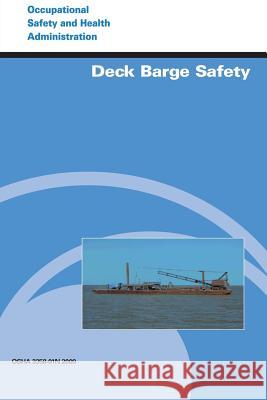
This publication presents guidance on preventing injuries and illnesses from workplace hazards on deck barges. Approximately 4,000 deck barges operate in the United States, using different types of winches and other equipment in a variety of operations. Employees on these vessels can face serious hazards. Between 1997 and 2006, 305 employees were killed on barge/tow combinations, and 379 explosions or fires occurred on barges or towboats, killing 14 employees. Some examples of these incidents are: 1) An employee was setting a steel pile upright in the water. The steel pile was being held...
This publication presents guidance on preventing injuries and illnesses from workplace hazards on deck barges. Approximately 4,000 deck barges operate...
U. S. Department of Labor Occupational Safety and Administration
This publication is intended to supplement OSHA's Small Entity Compliance Guide for the Hexavalent Chromium Standards published in 2006 and to give readers an overview of the provisions and requirements of the Hexavalent Chromium standards for general industry (29 CFR 1910.1026), shipyards (29 CFR 1915.1026), and construction (29 CFR 1926.1126). Hexavalent chromium (Cr(VI)) is a toxic form of the element chromium. Hexavalent chromium is rarely found in nature and is generally man-made. Cr(VI) is widely used in pigments, metal finishing (electroplating), wood preservatives and fungicides, and...
This publication is intended to supplement OSHA's Small Entity Compliance Guide for the Hexavalent Chromium Standards published in 2006 and to give re...
U. S. Department of Labor Occupational Safety and Administration
The dumping of hazardous substances poses a significant threat to the environment. The U.S. Environmental Protection Agency's (EPA) Toxic Release Inventory (TRI) data show that over 18 million tons of hazardous substances covered by TRI were disposed of or released into the environment from 1998 through 2004.1 Hazardous substances are a serious safety and health problem that continues to endanger human and animal life and environmental quality. Discarded hazardous substances that are toxic, flammable, or corrosive can cause fires, explosions, and pollution of air, water, and land. Unless...
The dumping of hazardous substances poses a significant threat to the environment. The U.S. Environmental Protection Agency's (EPA) Toxic Release Inve...
U. S. Department of Labor Occupational Safety and Administration
This booklet is for employers, foremen, and supervisors, but we encourage employees to use the information as well to analyze their own jobs and recognize workplace hazards so they can report them to you. It explains what a job hazard analysis is and offers guidelines to help you conduct your own step-by-step analysis. A hazard is the potential for harm. In practical terms, a hazard often is associated with a condition or activity that, if left uncontrolled, can result in an injury or illness. Identifying hazards and eliminating or controlling them as early as possible will help prevent...
This booklet is for employers, foremen, and supervisors, but we encourage employees to use the information as well to analyze their own jobs and recog...