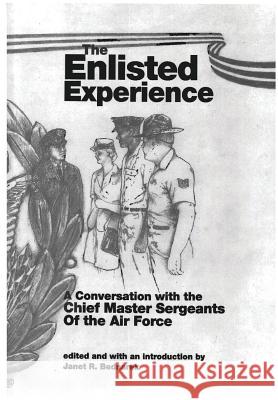
This manuscript offers a vivid, candid and highly personal account of military life by four of the first five Chief Master Sergeants of the Air Force. Their recollections were captured in an interview at Bolling Air Force Base in Washington, D.C. and cover a period of over thirty years - from the early 1940's to the late 1970's. The position of chief Master Sergeant of the Air Force (held by only 10 individuals since its establishment in 1966) has given all enlisted service members a representative who has direct access to, and the ability to advise, the Chief of Staff and the Secretary of...
This manuscript offers a vivid, candid and highly personal account of military life by four of the first five Chief Master Sergeants of the Air Force....
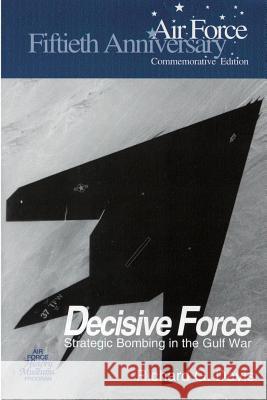
In the Persian Gulf War the U.S. Air Force (USAF) demonstrated that a new era in strategic bombing had begun. Air power could now destroy key portions of a county's military and economic infrastructure without resort to nuclear weapons and heavy bombers and with low losses to both the attacker and enemy civilians. This achievement rested on technology, which both increased bombing accuracy and decreased the effectiveness of enemy defenses, and the reexamination and reapplication of traditional strategic bombing theory by USAF planning officers.
In the Persian Gulf War the U.S. Air Force (USAF) demonstrated that a new era in strategic bombing had begun. Air power could now destroy key portions...
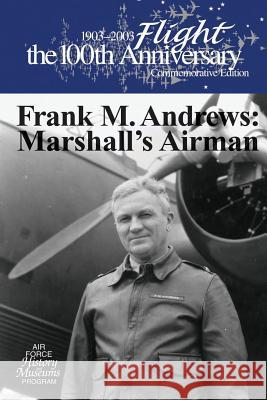
As we conclude our year-long recognition of the 100th anniversary of powered flight, we take this opportunity to recognize and pay tribute to airmen of the past and present. We do this with an eye toward inspiring airmen of the future. General Frank M. Andrews was an inspirational figure in our history and it is fitting that we highlight his accomplishments and contributions in the creation, shaping, and development of the United States Air Force. As the organizer and commander of the prewar General Headquarters (GHQ) Air Force, he was the first airman to have centralized nationwide command...
As we conclude our year-long recognition of the 100th anniversary of powered flight, we take this opportunity to recognize and pay tribute to airmen o...
Spanning the decades form the beginning of the Cold War to today's strategy of global engagement, the twenty-three operational summaries in this book illustrate each of the objective for military operations other than wart. The USAF conducted each of these contingencies in a combat zone or area of serious civil disturbance. Since the fall of the Berlin Wall, a series of geographically localized crises caused by political, religious or ethnic unrest; outright military aggression; and natural disasters has replaced the relative stability that characterized international relations for more than...
Spanning the decades form the beginning of the Cold War to today's strategy of global engagement, the twenty-three operational summaries in this book ...
This book was first published in 1987 and has proven an indispensable reference work for anyone interested in the history of the U.S. Air Force, and particularly, in the role that key individuals have played in its evolution. Many of the individuals profiled in this book are well-known to students of air and space power. All of them were dedicated to an ideal - to produce a new form of military force, a force that would achieve victory in war by exploitation and dominance of the third dimension. Includes discussions of Benjamin Foulois, Frank Andrews, Harold George, Hugh Knerr, George Kenney,...
This book was first published in 1987 and has proven an indispensable reference work for anyone interested in the history of the U.S. Air Force, and p...
This book looks at the Air Force's support of the ground war in South Vietnam between 1965 and 1968. The book covers the period of time when the United States began moving from an advisory role to one of active involvement to just before the time when the United Stated gradually began disengaging from the war. The final scene is the successful air campaign conducted during the Communists siege of the Marine camp at Khe Sanh. While the actual siege lasted from late January to the middle of March 1968, enemy preparations for the encirclement were seen as early as October 1967.
This book looks at the Air Force's support of the ground war in South Vietnam between 1965 and 1968. The book covers the period of time when the Unite...
During the perilous years of 1940-1941, a small band of Americans joined the Royal Air Force to help England resist Nazi Germany. They did so while the United States remained a neutral power and overcame significant obstacles to accomplish their objective. Over time, the RAF formed three fighter units, known collectively as the Eagle Squadrons, around these volunteer pilots. These Americans flew alongside their British comrades in fighter and bomber escort missions until 1942, when they transferred into the United States Army Air Forces. The Eagle Squadron pilots made noteworthy contributions...
During the perilous years of 1940-1941, a small band of Americans joined the Royal Air Force to help England resist Nazi Germany. They did so while th...
On the morning of May 18, 1916, a German LVG appeared in the sky over Thann in the Vosges region, near the ancient French city of Nancy. The LVG was a well-armed, two-seat observation airplane and the Vosges a quiet sector of the Western Front, in stark contrast to the merciless slaughter taking place to the north at Verdun. Normally the two airmen could expect to do their reconnaissance with little interruption, but on this day they had left luck behind. A speck appeared in the sky to the west and rapidly grew into an enemy pursuit aircraft, an avion de chasse, an agile, single-seat...
On the morning of May 18, 1916, a German LVG appeared in the sky over Thann in the Vosges region, near the ancient French city of Nancy. The LVG was a...
This insightful work holds many lessons in tactical air-ground operations. Despite peacetime rivalries in the drafting of service doctrine, in World War II the immense pressures of wartime drove army and air commanders to cooperate in the effective prosecution of battlefield operations. In northwest Europe during the war, the combination of U.S. Third Army commanded by Lt. Gen. George S. Patton and the XIX Tactical Air Command led by Brig. Gen. Otto P. Weyland proved to be the most effective allied air-ground team of World War II. The great success of Patton's drive across France, ultimately...
This insightful work holds many lessons in tactical air-ground operations. Despite peacetime rivalries in the drafting of service doctrine, in World W...
This volume deals with the early years of the United States Air Force's effort to build and maintain a strategic striking force, for 1945 through 1953. It discusses the period of reorganization in national defense in the years after the end of the Second World War, as Army Defense Forces dealt with the questions of structure, doctrine, strategy, atomic weapons, and technology. Crucial decisions were made at the end of 1947 and that beginning of 1948, but fiscal austerity limited the new United States Air Force in implementing those decisions. The war in Korea triggered and expansion of the...
This volume deals with the early years of the United States Air Force's effort to build and maintain a strategic striking force, for 1945 through 1953...