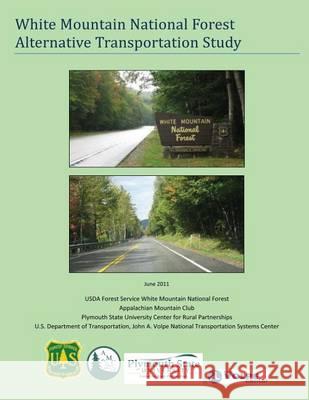
The White Mountain National Forest (WMNF) is one of the most visited federal lands for recreation in the country, attracting 1.7 million visitors annually. But growth in visitation to the WMNF is increasingly affecting the visitor experience and the WMNF's natural resources. This report documents a planning effort to improve car-free travel options in and around the forest. It documents visitor use trends and transportation issues, explores partnership opportunities for alternative transportation implementation; and identifies options for additional alternative transportation planning or...
The White Mountain National Forest (WMNF) is one of the most visited federal lands for recreation in the country, attracting 1.7 million visitors annu...
Increased visitation at Chimney Rock in the San Juan National Forest in southwest Colorado has led to increasing interest in the addition of a shuttle system. Piloting a shuttle system at Chimney Rock is a relatively low-cost option that the USFS could pursue along with its partners to test how an alternative transportation system may help to accommodate the increase in visitation and its impacts to safety and resource concerns. Piloting a shuttle for two full seasons of regular visitation and pertinent special events would be a prudent approach to gaining valid information that can be used...
Increased visitation at Chimney Rock in the San Juan National Forest in southwest Colorado has led to increasing interest in the addition of a shuttle...
Many comments have been received as a result of the Federal Railroad Administration's (FRA) issuance of a Proposed Rule for the "Use of Locomotive Horns at Highway-Rail Grade Crossings"1. This rule contains numerous provisions, two of which are addressed in this study. The first provision addressed in this study states that the sound level generated by the horn, when measured at the side of the locomotive, shall not exceed the sound level measured in front of the locomotive. In the late 1980's it became the de facto standard to install horns on the top/center portion of the locomotive. This...
Many comments have been received as a result of the Federal Railroad Administration's (FRA) issuance of a Proposed Rule for the "Use of Locomotive Hor...
Federal Land Management Agencies (FLMAs), including the U.S. Forest Service in the Department of Agriculture (USDA), and the Bureau of Land Management (BLM), Fish and Wildlife Service (FWS), and National Park Service (NPS), all in the Department of the Interior (DOI), are committed to the conservation and stewardship of the nation's public lands, and the cultural and natural resources within those lands. As part of this commitment, FLMAs continually strive to improve their environmental and energy performance. A key component of this goal is to reduce the petroleum consumption of FLMA...
Federal Land Management Agencies (FLMAs), including the U.S. Forest Service in the Department of Agriculture (USDA), and the Bureau of Land Management...
The Federal Motor Carriers Safety Administration (FMCSA) is concerned that truck drivers' exposure to high levels of air pollutants and mobile air toxics for potentially long periods of time, may lead to acute and/or long term cognitive impairments as a result. The goal of this project was to compile existing information addressing the following question: Does exposure to diesel exhaust at levels found in cabs affect driver safety performance by affecting driver sleep, alertness, reaction time, fatigue levels, or judgment-making abilities? To determine whether such an effect exists, the Volpe...
The Federal Motor Carriers Safety Administration (FMCSA) is concerned that truck drivers' exposure to high levels of air pollutants and mobile air tox...
There are many reasons to be concerned with estimating the frequency and social costs of highway accidents, but most reasons are motivated by a desire to minimize these costs to the extent feasible. Competition for scarce resources is a practical necessity, and society seeks to apply those resources where they will do the most good. With highway crashes, given the high costs of mis-prediction in fatalities and injuries, sound information for prioritizing projects with limited funds is essential.
There are many reasons to be concerned with estimating the frequency and social costs of highway accidents, but most reasons are motivated by a desire...
This report describes a study conducted to explore the utility and recognition of lines and linear patterns on electronic displays depicting aeronautical charting information.
This report describes a study conducted to explore the utility and recognition of lines and linear patterns on electronic displays depicting aeronauti...
This report draws upon eight State case studies to identify processes, experiences, and results of transit participation in statewide planning with a focus on non-urbanized or rural areas. Transit at the Table III is intended as a resource for organizations directly or indirectly involved in providing rural transit - state DOTs, regional planning organizations (RPOs), rural transit agencies, and their partners, including business, universities, Tribes, federal land management units, health care providers, and others. This study is the third in the "Transit at the Table" series on successful...
This report draws upon eight State case studies to identify processes, experiences, and results of transit participation in statewide planning with a ...