The Conduct of Life is a collection of essays by Ralph Waldo Emerson published in 1860 and revised in 1876. In this volume, Emerson sets out to answer "the question of the times: " "How shall I live?" It is composed of nine essays, each preceded by a poem. These nine essays are largely based on lectures Emerson held throughout the country, including for a young, mercantile audience in the lyceums of the Midwestern boomtowns of the 1850s. The Conduct of Life has been named as both one of Emerson's best works and one of his worst. It was one of Emerson's most successful publications and has...
The Conduct of Life is a collection of essays by Ralph Waldo Emerson published in 1860 and revised in 1876. In this volume, Emerson sets out to answer...
Ralph Waldo Emerson (May 25, 1803 - April 27, 1882), known professionally as Waldo Emerson, was an American essayist, lecturer, and poet who led the Transcendentalist movement of the mid-19th century. He was seen as a champion of individualism and a prescient critic of the countervailing pressures of society, and he disseminated his thoughts through dozens of published essays and more than 1,500 public lectures across the United States. Emerson gradually moved away from the religious and social beliefs of his contemporaries, formulating and expressing the philosophy of Transcendentalism in...
Ralph Waldo Emerson (May 25, 1803 - April 27, 1882), known professionally as Waldo Emerson, was an American essayist, lecturer, and poet who led the T...
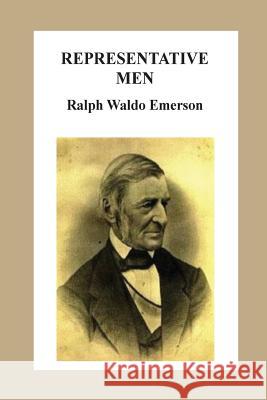
Representative Men is a collection of seven lectures by Ralph Waldo Emerson, published as a book of essays in 1850. The first essay discusses the role played by "great men" in society, and the remaining six each extoll the virtues of one of six men deemed by Emerson to be great: Plato ("the Philosopher") Emanuel Swedenborg ("the Mystic") Michel de Montaigne ("the Skeptic") William Shakespeare ("the Poet") Napoleon ("the Man of the World") Johann Wolfgang von Goethe ("the Writer")
Representative Men is a collection of seven lectures by Ralph Waldo Emerson, published as a book of essays in 1850. The first essay discusses the role...
Ralph Waldo Emerson (May 25, 1803 - April 27, 1882), known professionally as Waldo Emerson, was an American essayist, lecturer, and poet who led the Transcendentalist movement of the mid-19th century. He was seen as a champion of individualism and a prescient critic of the countervailing pressures of society, and he disseminated his thoughts through dozens of published essays and more than 1,500 public lectures across the United States. Emerson gradually moved away from the religious and social beliefs of his contemporaries, formulating and expressing the philosophy of Transcendentalism in...
Ralph Waldo Emerson (May 25, 1803 - April 27, 1882), known professionally as Waldo Emerson, was an American essayist, lecturer, and poet who led the T...
The Conduct of Life is a collection of essays by Ralph Waldo Emerson published in 1860 and revised in 1876. In this volume, Emerson sets out to answer "the question of the times: " "How shall I live?"It is composed of nine essays, each preceded by a poem. These nine essays are largely based on lectures Emerson held throughout the country, including for a young, mercantile audience in the lyceums of the Midwestern boomtowns of the 1850s. The Conduct of Life has been named as both one of Emerson's best works and one of his worst. It was one of Emerson's most successful publications and has been...
The Conduct of Life is a collection of essays by Ralph Waldo Emerson published in 1860 and revised in 1876. In this volume, Emerson sets out to answer...
In "Nature," Emerson lays out and attempts to solve an abstract problem: that humans do not fully accept nature's beauty. He writes that people are distracted by the demands of the world, whereas nature gives but humans fail to reciprocate. The essay consists of eight sections: Nature, Commodity, Beauty, Language, Discipline, Idealism, Spirit and Prospects. Each section takes a different perspective on the relationship between humans and nature. In the essay Emerson explains that to experience the "wholeness" with nature for which we are naturally suited, we must be separate from the flaws...
In "Nature," Emerson lays out and attempts to solve an abstract problem: that humans do not fully accept nature's beauty. He writes that people are di...
Representative Men is a collection of seven lectures by Ralph Waldo Emerson, published as a book of essays in 1850. The first essay discusses the role played by "great men" in society, and the remaining six each extoll the virtues of one of six men deemed by Emerson to be great: Plato ("the Philosopher") Emanuel Swedenborg ("the Mystic") Michel de Montaigne ("the Skeptic") William Shakespeare ("the Poet") Napoleon ("the Man of the World") Johann Wolfgang von Goethe ("the Writer")
Representative Men is a collection of seven lectures by Ralph Waldo Emerson, published as a book of essays in 1850. The first essay discusses the role...
Self-Reliance" is an 1841 essay written by American transcendentalist philosopher and essayist Ralph Waldo Emerson. It contains the most thorough statement of one of Emerson's recurrent themes, the need for each individual to avoid conformity and false consistency, and follow their own instincts and ideas. It is the source of one of Emerson's most famous quotations: "A foolish consistency is the hobgoblin of little minds, adored by little statesmen and philosophers and divines." 1] This essay is an analysis into the nature of the "aboriginal self on which a universal reliance may be...
Self-Reliance" is an 1841 essay written by American transcendentalist philosopher and essayist Ralph Waldo Emerson. It contains the most thorough stat...
Ralph Waldo Emerson (May 25, 1803 - April 27, 1882), known professionally as Waldo Emerson, was an American essayist, lecturer, and poet who led the Transcendentalist movement of the mid-19th century. He was seen as a champion of individualism and a prescient critic of the countervailing pressures of society, and he disseminated his thoughts through dozens of published essays and more than 1,500 public lectures across the United States. Emerson gradually moved away from the religious and social beliefs of his contemporaries, formulating and expressing the philosophy of Transcendentalism in...
Ralph Waldo Emerson (May 25, 1803 - April 27, 1882), known professionally as Waldo Emerson, was an American essayist, lecturer, and poet who led the T...
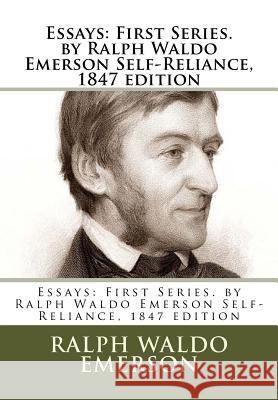
Essays: First Series, is a series of essays written by Ralph Waldo Emerson, published in 1841, concerning transcendentalism. This book contains: "History" "Self-Reliance" "Compensation" "Spiritual Laws" "Love" "Friendship" "Prudence" "Heroism" "The Over-Soul" "Circles" "Intellect" "Art" Essays: Second Series is a series of essays written by Ralph Waldo Emerson in 1844, concerning transcendentalism. It is the second volume of Emerson's Essays, the first being Essays: First Series. This book contains: "The Poet" "Experience" "Character" "Manners" "Gifts" "Nature" "Politics" "Nominalist and...
Essays: First Series, is a series of essays written by Ralph Waldo Emerson, published in 1841, concerning transcendentalism. This book contains: "Hist...