I started on my third excursion to the Maine woods Monday, July 20, 1857, with one companion, arriving at Bangor the next day at noon. The succeeding morning, a relative of mine who is well acquainted with the Penobscot Indians took me in his wagon to Oldtown to assist me in obtaining an Indian for this expedition. We were ferried across to the Indian Island in a bateau. The ferryman's boy had the key to it, but the father, who was a blacksmith, after a little hesitation, cut the chain with a cold chisel on the rock. He told me that the Indians were nearly all gone to the seaboard and to...
I started on my third excursion to the Maine woods Monday, July 20, 1857, with one companion, arriving at Bangor the next day at noon. The succeeding ...
I have met with but one or two persons in the course of my life who understood the art of Walking, that is, of taking walks-who had a genius, so to speak, for SAUNTERING, which word is beautifully derived "from idle people who roved about the country, in the Middle Ages, and asked charity, under pretense of going a la Sainte Terre," to the Holy Land, till the children exclaimed, "There goes a Sainte-Terrer," a Saunterer, a Holy-Lander. They who never go to the Holy Land in their walks, as they pretend, are indeed mere idlers and vagabonds; but they who do go there are saunterers in the good...
I have met with but one or two persons in the course of my life who understood the art of Walking, that is, of taking walks-who had a genius, so to sp...
I should not obtrude my affairs so much on the notice of my readers if very particular inquiries had not been made by my townsmen concerning my mode of life, which some would call impertinent, though they do not appear to me at all impertinent, but, considering the circumstances, very natural and pertinent. Some have asked what I got to eat; if I did not feel lonesome; if I was not afraid; and the like. Others have been curious to learn what portion of my income I devoted to charitable purposes; and some, who have large families, how many poor children I maintained. I will therefore ask those...
I should not obtrude my affairs so much on the notice of my readers if very particular inquiries had not been made by my townsmen concerning my mode o...
First, as to his history. I will endeavor to omit, as much as possible, what you have already read. I need not describe his person to you, for probably most of you have seen and will not soon forget him. I am told that his grandfather, John Brown, was an officer in the Revolution; that he himself was born in Connecticut about the beginning of this century, but early went with his father to Ohio. I heard him say that his father was a contractor who furnished beef to the army there, in the war of 1812; that he accompanied him to the camp, and assisted him in that employment, seeing a good deal...
First, as to his history. I will endeavor to omit, as much as possible, what you have already read. I need not describe his person to you, for probabl...
I heartily accept the motto, "That government is best which governs least"; and I should like to see it acted up to more rapidly and systematically. Carried out, it finally amounts to this, which also I believe-"That government is best which governs not at all"; and when men are prepared for it, that will be the kind of government which they will have. Government is at best but an expedient; but most governments are usually, and all governments are sometimes, inexpedient. The objections which have been brought against a standing army, and they are many and weighty, and deserve to prevail, may...
I heartily accept the motto, "That government is best which governs least"; and I should like to see it acted up to more rapidly and systematically. C...
I started on my third excursion to the Maine woods Monday, July 20, 1857, with one companion, arriving at Bangor the next day at noon. The succeeding morning, a relative of mine who is well acquainted with the Penobscot Indians took me in his wagon to Oldtown to assist me in obtaining an Indian for this expedition. We were ferried across to the Indian Island in a bateau. The ferryman's boy had the key to it, but the father, who was a blacksmith, after a little hesitation, cut the chain with a cold chisel on the rock. He told me that the Indians were nearly all gone to the seaboard and to...
I started on my third excursion to the Maine woods Monday, July 20, 1857, with one companion, arriving at Bangor the next day at noon. The succeeding ...
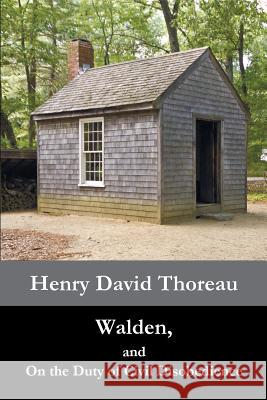
Thoreau's -Walden- is an American Classic. E. B. White writes, -Henry went forth to battle when he took to the woods, and Walden is the report of a man torn by two powerful and opposing drives-the desire to enjoy the world and the urge to set the world straight.- This edition, also containing Thoreau's essay -On the Duty of Civil Disobedience-, is in modern easy to read typeface.
Thoreau's -Walden- is an American Classic. E. B. White writes, -Henry went forth to battle when he took to the woods, and Walden is the report of a ma...
Henry David Thoreau (born David Henry Thoreau; July 12, 1817 - May 6, 1862) is one of America's most famous authors and poets, and one of the prominent writers of the Transcendentalist Era in the mid-19th century. Along with Ralph Waldo Emerson, who was a mentor of sorts to Thoreau, the two of them produced large bodies of work that formed the backbone of Transcendentalism. Thoreau in particular was an ardent abolitionist, naturalist, historian, philosopher, and also laid the groundwork for peaceful civil disobedience movements across the world in moral opposition to unjust states. Thoreau's...
Henry David Thoreau (born David Henry Thoreau; July 12, 1817 - May 6, 1862) is one of America's most famous authors and poets, and one of the prominen...
Thoreau's -Walden- is an American Classic. -Henry went forth to battle when he took to the woods, and Walden is the report of a man torn by two powerful and opposing drives-the desire to enjoy the world and the urge to set the world straight.- - E. B. White. This edition containing Thoreau's essay -On the Duty of Civil Disobedience- is in modern easy to read typeface.
Thoreau's -Walden- is an American Classic. -Henry went forth to battle when he took to the woods, and Walden is the report of a man torn by two powerf...
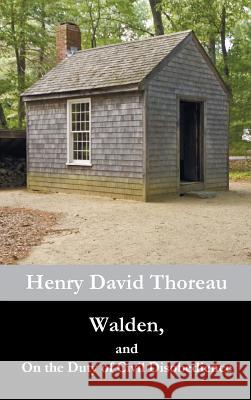
Robert Frost wrote of Thoreau, "In one book... he gave America the best of all we had." Henry David Thoreau is best known as the American author of "Walden" who wanted first-hand to experience and understand deeply the inspiring connection between man and nature. He built a humble cabin by his own hands beside Walden Pond with tools borrowed from his Concord neighbors and sustained by the fruits of the bean field sown in his garden and those resources yielded up to him by the wilderness. He seeks to transcend inauthentic, everyday life in Concord and awaken his soul to the beauty and harmony...
Robert Frost wrote of Thoreau, "In one book... he gave America the best of all we had." Henry David Thoreau is best known as the American author of "W...