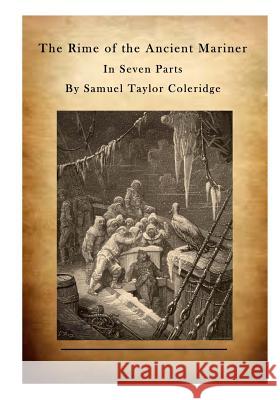
The Rime of the Ancient Mariner relates the experiences of a sailor who has returned from a long sea voyage. The mariner stops a man who is on the way to a wedding ceremony and begins to narrate a story. The wedding-guest's reaction turns from bemusement to impatience to fear to fascination as the mariner's story progresses, as can be seen in the language style: Coleridge uses narrative techniques such as personification and repetition to create a sense of danger, the supernatural, or serenity, depending on the mood in different parts of the poem.
The Rime of the Ancient Mariner relates the experiences of a sailor who has returned from a long sea voyage. The mariner stops a man who is on the way...
The Rime of the Ancient Mariner (originally The Rime of the Ancyent Marinere) is the longest major poem by the English poet Samuel Taylor Coleridge, written in 1797-98 and published in 1798 in the first edition of Lyrical Ballads. Modern editions use a revised version printed in 1817 that featured a gloss. Along with other poems in Lyrical Ballads, it was a signal shift to modern poetry and the beginning of British Romantic literature.
The Rime of the Ancient Mariner relates the experiences of a sailor who...
The Rime of the Ancient Mariner
In Seven Parts
By Samuel Taylor Coleridge
The Rime of the Ancient Mariner (originally The Rime of the Ancyent...
The work was originally intended as a mere preface to a collected volume of his poems, explaining and justifying his own style and practice in poetry. The work grew to a literary autobiography, including, together with many facts concerning his education and studies and his early literary adventures, an extended criticism of William Wordsworth's theory of poetry as given in the preface to the Lyrical Ballads (a work on which Coleridge collaborated), and a statement of Coleridge's philosophical views. In the first part of the work Coleridge is mainly concerned with showing the evolution of his...
The work was originally intended as a mere preface to a collected volume of his poems, explaining and justifying his own style and practice in poetry....
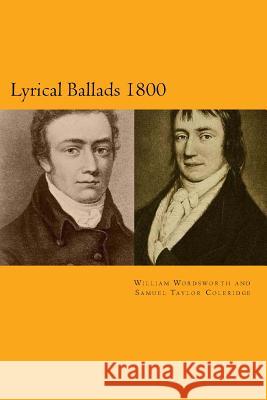
William Wordsworth Samuel Taylor Coleridge Nigel Nelson
The publication of Lyrical Ballads was English poetry's defining moment; its revolutionary style and content influencing every poet who followed from 1798 to the present day. Poetry of the head became poetry of the heart and soul. The additional poems in this, the expanded 1800 edition, include many of the best loved in the language, and marked the first appearance of Wordsworth's controversial Preface. Nigel Nelson is a distinguished Fleet Street journalist of 40 years standing, and he has brought that experience to bear on painstaking and original research for a brilliant reassessment of...
The publication of Lyrical Ballads was English poetry's defining moment; its revolutionary style and content influencing every poet who followed from ...
Coleridge's Aids to Reflection was written at a time when new movements in thought were starting to unsettle belief. It was read with admiration by early Victorians such as John Sterling, F. D. Maurice, and Thomas Arnold, contributing to the formation of the Broad Church Movement, and with respect by members of the High Church Movement, including John Henry Newman. Coleridge had intended simply to produce a selection from the writings of the seventeenth-century Archbishop Robert Leighton with comments of his own, but as he worked at the book he found the commentary expanding to take...
Coleridge's Aids to Reflection was written at a time when new movements in thought were starting to unsettle belief. It was read with admira...