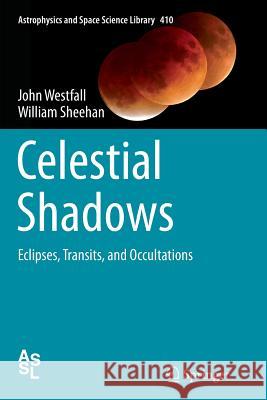
Much of what is known about the universe came from the study of celestial shadows. This book looks in detail at the way eclipses and other celestial shadows have given us amazing insights into the nature of the objects in our solar system and how they are even helping us discover and analyze planets that orbit stars other than our Sun. A variety of eclipses, transits, and occultations of the mooons of Jupiter and Saturn, Pluto and its satellite Charon, asteroids and stars have helped astronomers to work out their dimensions, structures, and shapes - even the existence of atmospheres and...
Much of what is known about the universe came from the study of celestial shadows. This book looks in detail at the way eclipses and other celestia...
Camille Flammarion (1842-1925) began his career at 16 as a human computer under the great mathematician U. J. J. Le Verrier at the Paris Observatory. He soon tired of the drudgery; he was drawn to more romantic vistas, and at 19 wrote a book on an idea that he was to make his own-the habitability of other worlds. There followed a career as France's greatest popularizer of astronomy, with over 60 titles to his credit. An admirer granted him a chateau at Juvisy-sur-l'Orge, and he set up a first-rate observatory dedicated to the study of the planet Mars. Finally, in 1892, he published his...
Camille Flammarion (1842-1925) began his career at 16 as a human computer under the great mathematician U. J. J. Le Verrier at the Paris Observatory. ...
Do we really know what we see through a telescope? How does the ocular system construct planetary images, and how does the brain interpret them? Drawing on both astronomical and psychological data, William Sheehan now offers the first systematic analysis of the perceptual and cognitive factors that go into the initial structuring of a planetary image and its subsequent elaboration. Sheehan details the development of lunar and planetary astronomy beginning with Galileo's study of the moon, and focuses particularly on the discover of "canals" on Mars. Through each episode he underscores...
Do we really know what we see through a telescope? How does the ocular system construct planetary images, and how does the brain interpret them...
Much of what is known about the universe came from the study of celestial shadows. This book looks in detail at the way eclipses and other celestial shadows have given us amazing insights into the nature of the objects in our solar system and how they are even helping us discover and analyze planets that orbit stars other than our Sun. A variety of eclipses, transits, and occultations of the mooons of Jupiter and Saturn, Pluto and its satellite Charon, asteroids and stars have helped astronomers to work out their dimensions, structures, and shapes - even the existence of atmospheres and...
Much of what is known about the universe came from the study of celestial shadows. This book looks in detail at the way eclipses and other celestia...
Provides an authoritative account of the exploration of Pluto and its moons, from the first inklings of tentative knowledge through the exciting discoveries made during the flyby of the NASA research spacecraft New Horizons in July 2015. Dale P. Cruikshank was co-investigator on the New Horizons mission, while William Sheehan is a noted historian of the solar system.
Provides an authoritative account of the exploration of Pluto and its moons, from the first inklings of tentative knowledge through the exciting disco...