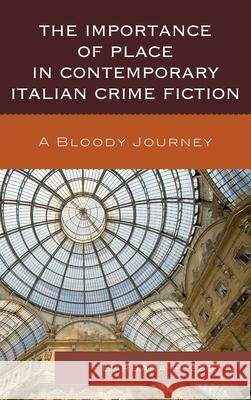
By taking as its point of departure the privileged relationship between the crime novel and its setting, this book is the most wide-ranging examination of the way in which Italian detective fiction in the last twenty years has become a means to articulate the changes in the social landscape of the country. Nowadays there is a general acknowledgment of the importance of place in Italian crime novels. However, apart from a limited scholarship on single cities, the genre has never been systematically studied in a way that so comprehensively spans Italian national boundaries. The originality of...
By taking as its point of departure the privileged relationship between the crime novel and its setting, this book is the most wide-ranging examinatio...
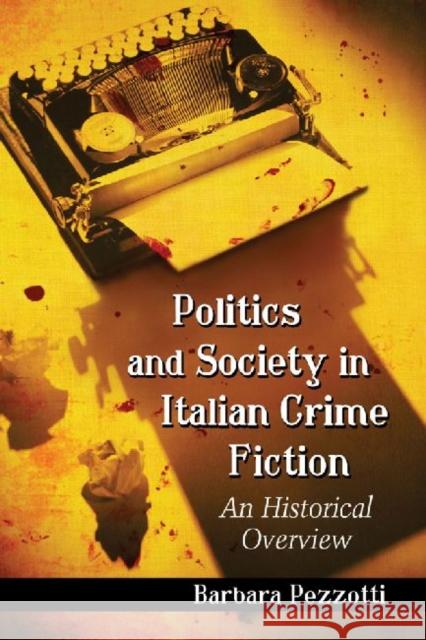
This book comprehensively covers the history of Italian crime fiction from its origins to the present. Using the concept of moral rebellion, the author examines the ways in which Italian crime fiction has articulated the country s social and political changes. The book concentrates on such writers as Augusto de Angelis (1888 1944), Giorgio Scerbanenco (1911 1969), Leonardo Sciascia (1921 1989), Andrea Camilleri (b. 1925), Loriano Macchiavelli (b. 1934), Massimo Carlotto (b. 1956), and Marcello Fois (b. 1960). Through the analysis of writers belonging to differing crucial periods of Italy s...
This book comprehensively covers the history of Italian crime fiction from its origins to the present. Using the concept of moral rebellion, the autho...
'The foreigner' is a familiar character in popular crime fiction, from the foreign detective whose outsider status provides a unique perspective on a familiar or exotic location to the xenophobic portrayal of the criminal 'other'. Exploring popular crime fiction from across the world, The Foreign in International Crime Writing examines these popular works as 'transcultural contact zones' in which writers can tackle such issues as national identity, immigration, globalization and diaspora communities. Offering readings of 20th and 21st-century crime writing from Norway, the UK, India,...
'The foreigner' is a familiar character in popular crime fiction, from the foreign detective whose outsider status provides a unique perspective on...
By taking as its point of departure the privileged relationship between the crime novel and its setting, this book is the most wide-ranging examination of the way in which Italian detective fiction in the last twenty years has become a means to articulate the changes in the social landscape of the country. Nowadays there is a general acknowledgment of the importance of place in Italian crime novels. However, apart from a limited scholarship on single cities, the genre has never been systematically studied in a way that so comprehensively spans Italian national boundaries. The originality of...
By taking as its point of departure the privileged relationship between the crime novel and its setting, this book is the most wide-ranging examinatio...
Serial Crime Fiction is the first book to focus explicitly on the complexities of crime fiction seriality. Covering definitions and development of the serial form, implications of the setting, and marketing of the series, it studies authors such as Doyle, Sayers, Paretsky, Ellroy, Marklund, Camilleri, Borges, across print, film and television.
Serial Crime Fiction is the first book to focus explicitly on the complexities of crime fiction seriality. Covering definitions and development of the...
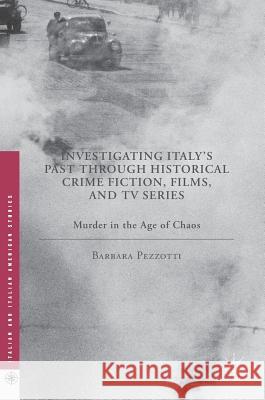
This book is the first monograph in English that comprehensively examines the ways in which Italian historical crime novels, TV series, and films have become a means to intervene in the social and political changes of the country. This study explores the ways in which fictional representations of the past mirror contemporaneous anxieties within Italian society in the work of writers such as Leonardo Sciascia, Andrea Camilleri, Carlo Lucarelli, Francesco Guccini, Loriano Macchiavelli, Marcello Fois, Maurizio De Giovanni, and Giancarlo De Cataldo; film directors such as Elio Petri, Pietro...
This book is the first monograph in English that comprehensively examines the ways in which Italian historical crime novels, TV series, and films have...
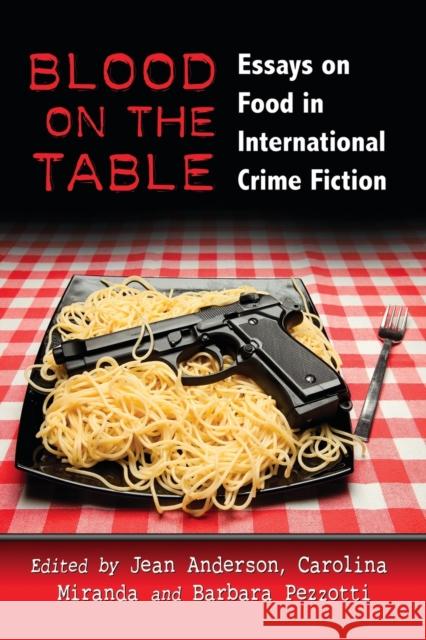
Focuses on the semiotics of food in crime fiction. Tackling the subject from a multicultural and interdisciplinary perspective, it includes approaches from cultural studies, food studies, media studies and crime fiction studies. Thus the collection investigates how the representation of food's convivial aspects and of eating rituals can also point to complex discourses about cultural belonging.
Focuses on the semiotics of food in crime fiction. Tackling the subject from a multicultural and interdisciplinary perspective, it includes approaches...