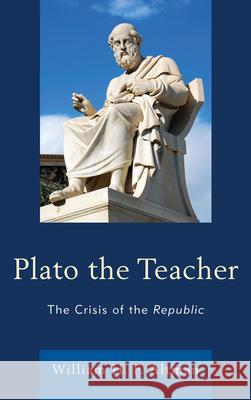
In this unique and important book, William Altman shines a light on the pedagogical technique of the playful Plato, especially his ability to create living discourses that directly address the student. Reviving an ancient concern with reconstructing the order in which Plato intended his dialogues to be taught as opposed to determining the order in which he wrote them, Altman breaks with traditional methods by reading Plato's dialogues as a multiplex but coherent curriculum in which the Allegory of the Cave occupies the central place. His reading of Plato's Republic challenges the true...
In this unique and important book, William Altman shines a light on the pedagogical technique of the playful Plato, especially his ability to create l...
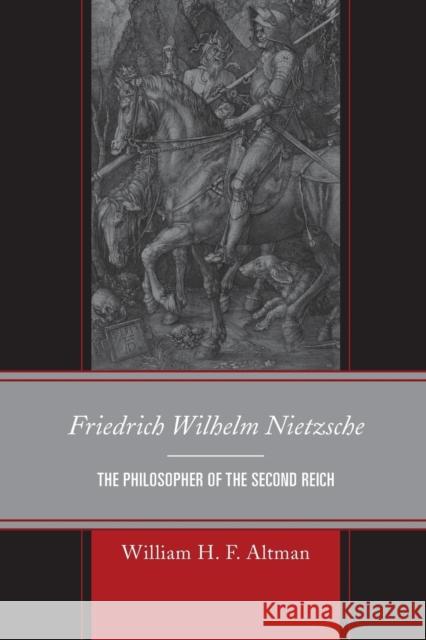
When careful consideration is given to Nietzsche's critique of Platonism and to what he wrote about Bismarck, Kaiser Wilhelm, and to Germany's place in "international relations" (die Groe Politik), the philosopher's carefully cultivated "pose of untimeliness" is revealed to be an imposture. As William H. F. Altman demonstrates, Nietzsche should be recognized as the paradigmatic philosopher of the Second Reich, the short-lived and equally complex German Empire that vanished in World War One. Since Nietzsche is a brilliant stylist whose seemingly disconnected aphorisms have made him notoriously...
When careful consideration is given to Nietzsche's critique of Platonism and to what he wrote about Bismarck, Kaiser Wilhelm, and to Germany's place i...
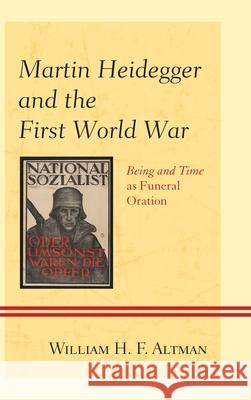
In a 1934 speech, marking the Twenty-fifth Reunion of his high school class, Martin Heidegger spoke eloquently of classmates killed in the Great War and called on his audience to recognize that the national rebirth now occuring in Hitler's Germany must continue to draw inspiration from the war dead. In this process, he refers to the war of 1914-1918 as "the First World War." Since the condition for the possibility of "the First" is a Second World War, Martin Heidegger and the First World War raises the question: how could Heidegger have already known in 1934 that another war was coming? The...
In a 1934 speech, marking the Twenty-fifth Reunion of his high school class, Martin Heidegger spoke eloquently of classmates killed in the Great War a...
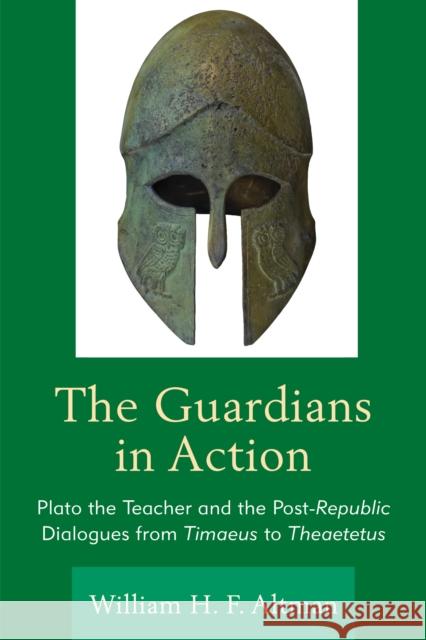
If you ve ever wondered why Plato staged Timaeus as a kind of sequel to Republic, or who its unnamed missing fourth might be; or why he joined Critias to Timaeus, and whether or not that strange dialogue is unfinished; or what we should make of the written critique of writing in Phaedrus, and of that dialogue s apparent lack of unity; or what is the purpose of the long discussion of the One in the second half of Parmenides, and how it relates to the objections made to the Theory of Forms in its first half; or if the revisionists or unitarians are right about Philebus, and why its Socrates...
If you ve ever wondered why Plato staged Timaeus as a kind of sequel to Republic, or who its unnamed missing fourth might be; or why he joined Critias...
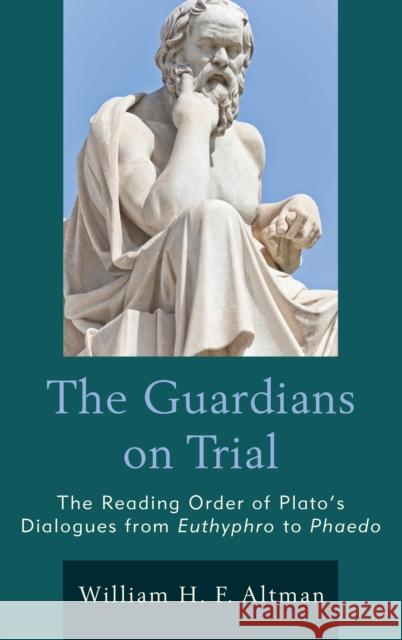
Based on a conception of Reading Order introduced and developed in his Plato the Teacher: The Crisis of the Republic (Lexington; 2012) and The Guardians in Action: Plato the Teacher and the Post-Republic Dialogues from Timaeus to Theaetetus (Lexington; 2016), William H. F. Altman now completes his study of Plato's so-called -late dialogues- by showing that they include those that depict the trial and death of Socrates. According to Altman, it is not Order of Composition but Reading Order that makes Euthyphro, Apology of Socrates, Crito, and Phaedo -late dialogues, - and he shows why Plato's...
Based on a conception of Reading Order introduced and developed in his Plato the Teacher: The Crisis of the Republic (Lexington; 2012) and The Guardia...