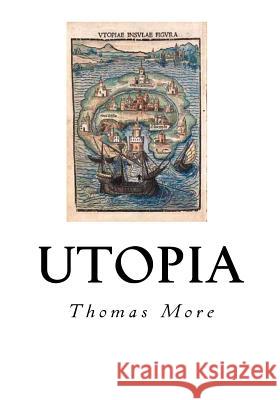
The work begins with written correspondence between Thomas More and several people he had met on the continent: Peter Gilles, town clerk of Antwerp, and Hieronymus van Busleyden, counselor to Charles V. More chose these letters, which are communications between actual people, to further the plausibility of his fictional land. In the same spirit, these letters also include a specimen of the Utopian alphabet and its poetry. The letters also explain the lack of widespread travel to Utopia; during the first mention of the land, someone had coughed during announcement of the exact longitude and...
The work begins with written correspondence between Thomas More and several people he had met on the continent: Peter Gilles, town clerk of Antwerp, a...
First published in 1516, Thomas More's Utopia is one of the most important works of European humanism. Through the voice of the mysterious traveler Raphael Hythloday, More describes a pagan, communist city-state governed by reason. Addressing such issues as religious pluralism, women's rights, state-sponsored education, colonialism, and justified warfare, Utopia seems remarkably contemporary nearly five centuries after it was written, and it remains a foundational text in philosophy and political theory.
First published in 1516, Thomas More's Utopia is one of the most important works of European humanism. Through the voice of the mysterious traveler Ra...
Sir Thomas More, venerated by Catholics as Saint Thomas More, was an English lawyer, social philosopher, author, statesman and noted Renaissance humanist. He was also a councillor to Henry VIII, and Lord High Chancellor of England from October 1529 to 16 May 1532.
Sir Thomas More, venerated by Catholics as Saint Thomas More, was an English lawyer, social philosopher, author, statesman and noted Renaissance human...