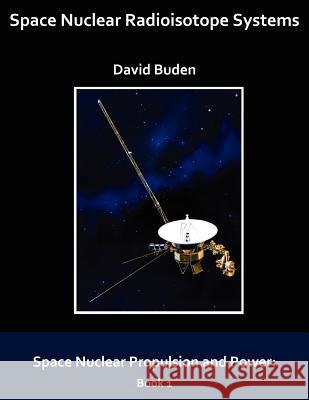
For operating in severe environments, long life and reliability, radioisotope power systems have proven to be the most successful of all space power sources. Two Voyager missions launched in 1977 to study Jupiter, Saturn, Uranus, Neptune, and their satellites, rings and magnetic fields and continuing to the heliosphere region are still functioning over thirty years later. Radioisotope power systems have been used on the Moon, exploring the planets, and exiting our solar system. There success is a tribute to the outstanding engineering, quality control and attention to details that went into...
For operating in severe environments, long life and reliability, radioisotope power systems have proven to be the most successful of all space power s...
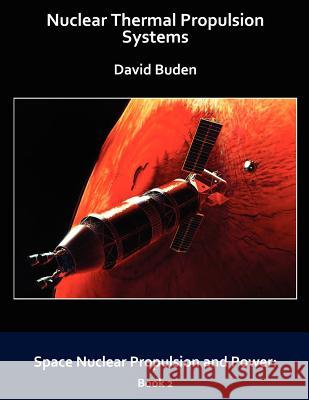
Interest in rockets that use fission reactors as the heat source has centered on manned flights to Mars. The demands of such missions require rockets that are several times more powerful than the chemical rockets in use today. Rocket engines operate according to the basic principles expressed in Newton's third law of motion: for every action there is an equal and opposite reaction. In a chemical rocket, hot gases are created by chemical combustion; in a nuclear rocket heating of the propellant in a nuclear reactor creates hot gas. In either case, the hot gases flow through the throat of the...
Interest in rockets that use fission reactors as the heat source has centered on manned flights to Mars. The demands of such missions require rockets ...
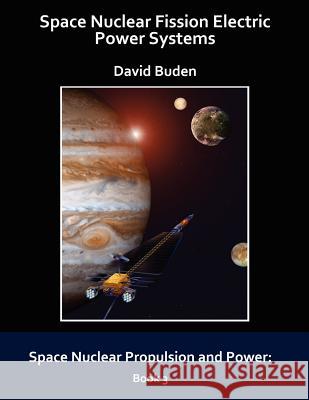
The advantages of space nuclear fission power systems can be summarized as: compact size; low to moderate mass; long operating lifetimes; the ability to operate in extremely hostile environments; operation independent of the distance from the Sun or of the orientation to the Sun; and high system reliability and autonomy. In fact, as power requirements approach the tens of kilowatts and megawatts, fission nuclear energy appears to be the only realistic power option. The building blocks for space nuclear fission electric power systems include the reactor as the heat source, power generation...
The advantages of space nuclear fission power systems can be summarized as: compact size; low to moderate mass; long operating lifetimes; the ability ...