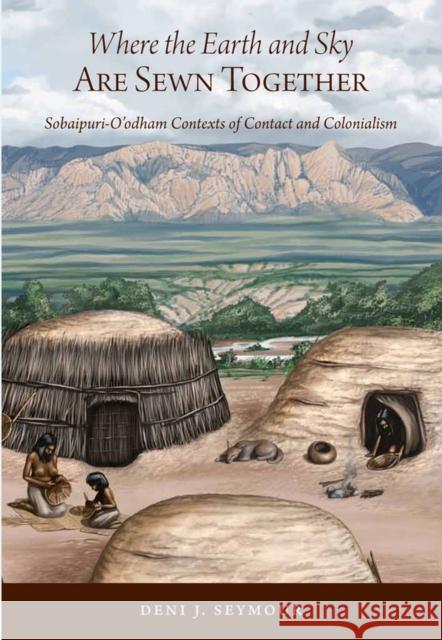
The Sobaipuri-O odham occupied the San Pedro and Santa Cruz valleys of southern Arizona from the 1400s. Their descendants reside at the contemporary community if Wa: k (San Xavier del Bac). Most of the protohistory and history concerning the Sobaipuri-O odham has been gleaned from documents written by the early Spanish colonizers and other Europeans and emphasizes the influence of Father Eusebio Kino; there are few accounts of the indigenous people themselves.In recent years, however, archaeological surveys and excavations in southern Arizona have revealed new information about this group....
The Sobaipuri-O odham occupied the San Pedro and Santa Cruz valleys of southern Arizona from the 1400s. Their descendants reside at the contemporar...
The Athapaskan departure from the Canadian Subarctic centuries ago and their subsequent arrival in the American Southwest has remained the subject of continuous debate in anthropological research. This book examines archaeological, genetic, linguistic, and traditional oral history data and brings them together in fresh ways, in many cases for the first time. With a backdrop of these new and interrelated lines of evidence, each subfield must now reevaluate its approach and the forms of evidence it uses to construct arguments. The contributors here include the most knowledgeable scholars...
The Athapaskan departure from the Canadian Subarctic centuries ago and their subsequent arrival in the American Southwest has remained the subject ...
In 1698, the Apache and their allies attacked a sleeping Sobaipuri-O odham village on the San Pedro River at the northern edge of New Spain, now in southern Arizona. This book, about one of the most important Southwestern battles of the era in this region, reads like a mystery. At the same time, it addresses in a scholarly fashion the methodological question of how we can confidently infer anything reliable about the past. Translations of original Spanish accounts by Father Kino and others convey important details about the battle, while the archaeological record and ethnographic and...
In 1698, the Apache and their allies attacked a sleeping Sobaipuri-O odham village on the San Pedro River at the northern edge of New Spain, now in so...
Trending upward as an archaeological field of study, protohistoric mobile groups provide fascinating new directions for cutting-edge research in the American Southwest and beyond. These mobile residents represent the ancient and ancestral roots of many modern indigenous peoples, including the Apaches, Jumano, Yavapai, and Ute. These important protohistoric and historic mobile people have tended to be ignored because their archaeological sites were deemed too difficult to identify, too scant to be worthy of study, and too different to incorporate. This book brings together information from...
Trending upward as an archaeological field of study, protohistoric mobile groups provide fascinating new directions for cutting-edge research in th...
In April 1780, Military Governor Ugarte and Chief Engineer Rocha were sent on a reconnaissance mission through the northwestern frontier of New Spain, land that today is northern Sonora and southeastern Arizona. Their accounts provide valuable baseline information on environment and culture that allows for analysis of changes at a critical moment in borderland history.
In April 1780, Military Governor Ugarte and Chief Engineer Rocha were sent on a reconnaissance mission through the northwestern frontier of New Spain,...