Rene Descartes: Abhandlung uber die Methode, richtig zu denken und Wahrheit in den Wissenschaften zu suchen Erstdruck (anonym) unter dem Titel Discours de la methode pour bien conduire sa raison et chercher la verite dans les sciences in: Essais, Leiden 1637. Text nach der Ubersetzung durch Julius Heinrich von Kirchmann von 1870. Vollstandige Neuausgabe mit einer Biographie des Autors. Herausgegeben von Karl-Maria Guth. Berlin 2013. Textgrundlage ist die Ausgabe: Rene Descartes' philosophische Werke. Ubersetzt, erlautert und mit einer Lebensbeschreibung des Descartes versehen von J. H. von...
Rene Descartes: Abhandlung uber die Methode, richtig zu denken und Wahrheit in den Wissenschaften zu suchen Erstdruck (anonym) unter dem Titel Discour...
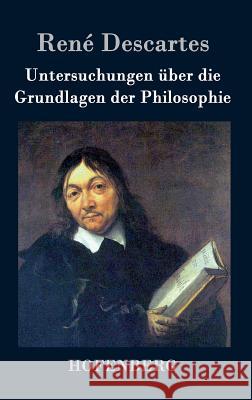
Rene Descartes: Untersuchungen uber die Grundlagen der Philosophie Entstanden 1628/29. Erstdruck unter dem Titel Meditationes de prima philosophia, in qua dei existentia et animae immortalis demonstratur, Paris 1641. Text nach der Ubersetzung durch Julius Heinrich von Kirchmann von 1870. Vollstandige Neuausgabe mit einer Biographie des Autors. Herausgegeben von Karl-Maria Guth. Berlin 2014. Textgrundlage ist die Ausgabe: Rene Descartes' philosophische Werke. Ubersetzt, erlautert und mit einer Lebensbeschreibung des Descartes versehen von J. H. von Kirchmann, Abteilung I-III, Berlin: L....
Rene Descartes: Untersuchungen uber die Grundlagen der Philosophie Entstanden 1628/29. Erstdruck unter dem Titel Meditationes de prima philosophia, in...
Ubersicht der sechs folgenden Betrachtungen. Fussnote] In der ersten Betrachtung werden die Grunde auseinandergesetzt, weshalb wir an allen, besonders aber an den materiellen Dingen zweifeln konnen; naturlich nur solange unser Wissen nicht festere Grundlagen hat als bisher Allerdings durfte wohl der Wert eines so umfassenden Zweifels nicht auf den ersten Blick klar sein. Er ist aber gleichwohl sehr gross, insofern er uns namlich von allen Vorurteilen befreit und uns am leichtesten in den Stand setzt, den Verstand von den Sinnen abzulenken. Zugleich bewirkt er auch, dass wir an dem, was wir...
Ubersicht der sechs folgenden Betrachtungen. Fussnote] In der ersten Betrachtung werden die Grunde auseinandergesetzt, weshalb wir an allen, besonder...
The Discourse on the Method (French: Discours de la methode) is a philosophical and autobiographical treatise published by Rene Descartes in 1637. Its full name is Discourse on the Method of Rightly Conducting One's Reason and of Seeking Truth in the Sciences (French title: Discours de la methode pour bien conduire sa raison, et chercher la verite dans les sciences). The Discourse on The Method is best known as the source of the famous quotation "Je pense, donc je suis" ("I think, therefore I am"), which occurs in Part IV of the work. (The similar statement in Latin, Cogito ergo sum, is found...
The Discourse on the Method (French: Discours de la methode) is a philosophical and autobiographical treatise published by Rene Descartes in 1637. Its...
Le Discours de la methode (sous-titre Pour bien conduire sa raison, et chercher la verite dans les sciences) est le premier texte philosophique publie par Rene Descartes a La Haye le 8 juin 1637. Dans les premieres editions, ce discours servait d'introduction a trois traites scientifiques mettant en application cette methode: La Dioptrique, Les Meteores et La Geometrie. Pour Descartes, il s'agit d'en dire assez pour faire juger que les nouvelles opinions, qui se verraient dans la Dioptrique et dans les Meteores, n'etaient point concues a la legere 1. Toutefois, sa celebrite est devenue telle,...
Le Discours de la methode (sous-titre Pour bien conduire sa raison, et chercher la verite dans les sciences) est le premier texte philosophique publie...
Principles of Philosophy (Latin: Principia philosophiae) is a book by Rene Descartes. In essence it is a synthesis of the Discourse on Method and Meditations on First Philosophy It was written in Latin, published in 1644 and dedicated to Elisabeth of Bohemia, with whom Descartes had a long-standing friendship. A French version (Les Principes de la Philosophie) followed in 1647. It set forth the principles of nature-the Laws of Physics-as Descartes viewed them. Most notably, it set forth the principle that in the absence of external forces, an object's motion will be uniform and in a straight...
Principles of Philosophy (Latin: Principia philosophiae) is a book by Rene Descartes. In essence it is a synthesis of the Discourse on Method and Medi...
Rene Descartes is often credited with being the "Father of Modern Philosophy." This title is justified due both to his break with the traditional Scholastic-Aristotelian philosophy prevalent at his time and to his development and promotion of the new, mechanistic sciences. His fundamental break with Scholastic philosophy was twofold. First, Descartes thought that the Scholastics' method was prone to doubt given their reliance on sensation as the source for all knowledge. Second, he wanted to replace their final causal model of scientific explanation with the more modern, mechanistic model....
Rene Descartes is often credited with being the "Father of Modern Philosophy." This title is justified due both to his break with the traditional Scho...
El Discurso del metodo, cuyo titulo completo es Discurso del metodo para conducir bien la propia razon y buscar la verdad en las ciencias (Discours de la methode pour bien conduire sa raison, et chercher la verite dans les sciences) es la principal obra escrita por Rene Descartes y una obra fundamental de la filosofia occidental con implicaciones para el desarrollo de la filosofia y de la ciencia. Se publico de forma anonima en Leiden (Holanda) en el ano 1637. Constituia, en realidad, el prologo a tres ensayos: Dioptrica, Meteoros y Geometria; agrupados bajo el titulo conjunto de Ensayos...
El Discurso del metodo, cuyo titulo completo es Discurso del metodo para conducir bien la propia razon y buscar la verdad en las ciencias (Discours de...