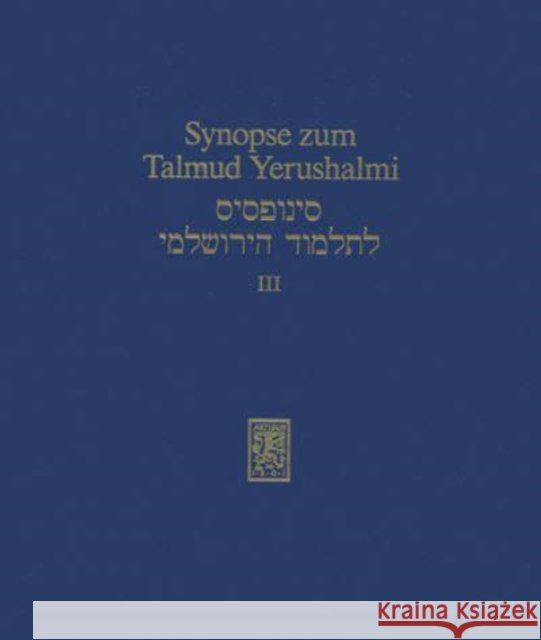
Since the textual evidence of the Talmud Yerushalmi is very shaky, it was not possible to present a critical edition in the traditional sense. Using the edited manuscripts and prints, it is the editors' intention to provide a framework of the textual evidence of the Talmud Yerushalmi in the period between the 13th century and 1710 as defined by these textual witnesses. This form of the synoptic edition is consistent with their intention, since it leaves it up to the user to decide on the quality of individual versions and to evaluate the various text traditions. The division of the texts into...
Since the textual evidence of the Talmud Yerushalmi is very shaky, it was not possible to present a critical edition in the traditional sense. Using t...
Hans-Jurgen Becker Martin Hengel Frowald Gil Huttenmeister
English summary: Andreas Lehnardt presents an annotated translation of the Rosh ha-Shana (New Year) Tractate of the Jerusalem Talmud (Talmud Yerushalmi) into German. The translation is based on the Krotoszyn edition, published in 1865/66, but also takes into account those manuscripts and prints edited in the Synopsis of the Talmud Yerushalmi as well as some indirect textual witnesses. In the detailed commentary, the author explains all substantial interpretation and translation problems with the help of the traditional commentaries and the secondary literature. A bibliography and explanations...
English summary: Andreas Lehnardt presents an annotated translation of the Rosh ha-Shana (New Year) Tractate of the Jerusalem Talmud (Talmud Yerushalm...
Hans-Jurgen Becker Martin Hengel Frowald Gil Huttenmeister
English summary: Andreas Lehnardt presents an annotated translation of the Besa (Egg) Tractate of the Jerusalem Talmud (Talmud Yerushalmi) into German. The translation is based on the Krotoszyn edition, published in 1865/66, but also takes into account those manuscripts and prints edited in the Synopsis of the Talmud Yerushalmi as well as some indirect textual witnesses. In the detailed commentary, the author explains all substantial interpretation and translation problems with the help of the traditional commentaries and the secondary literature. A bibliography and explanations of the...
English summary: Andreas Lehnardt presents an annotated translation of the Besa (Egg) Tractate of the Jerusalem Talmud (Talmud Yerushalmi) into German...
English summary: Andreas Lehnardt presents an annotated German translation of the Tractate Pesahim (Passover) of the Talmud Yerushalmi. The translation is based on the Krotoszyn edition, but takes also into account those manuscripts and prints edited in the Synopsis of the Talmud Yerushalmi as well as some indirect textual witnesses and Geniza fragments. In a detailed commentary, the author explains all substantial interpretation and translation problems with the help of the traditional commentaries and the secondary literature. A bibliography and explanations of the methodology have also...
English summary: Andreas Lehnardt presents an annotated German translation of the Tractate Pesahim (Passover) of the Talmud Yerushalmi. The translatio...
English summary: The Shabbat treatise is the longest in the Talmud Yerushalmi. It deals with the rules on the observation of the Shabbat, which is more important than the holidays. The basic commandment to rest is dealt with in detail in all areas of daily life, such as cooking, sewing, building, writing, harvesting, caring for the poor, travelling, shipping, dentistry, circumcision etc. There is a detailed commentary of Gil Frowald Huttenmeister's translation, and the modern secondary literature as well as the traditional commentaries are taken into consideration. The indexes, including an...
English summary: The Shabbat treatise is the longest in the Talmud Yerushalmi. It deals with the rules on the observation of the Shabbat, which is mor...
Friedrich Avemarie Hans-Jurgen Becker Martin Hengel
English summary: The tractate Ketubbot, the second tractate in the order of Nashim (Women), deals with the laws relating to marriage discussing and defining the mutual duties and privileges of both spouses and the minimal amount of the marriage contract to which the wife is entitled in the case of her husband's death or in the case of divorce. Other topics bear on questions of the penalty in the absence of her virginity and adultery, and compensation and fines relating to the violation or seduction of certain classes of women. Discussions on the disposal of money, goods, slaves or property...
English summary: The tractate Ketubbot, the second tractate in the order of Nashim (Women), deals with the laws relating to marriage discussing and de...
English summary: Following the analysis of the Hebrew basis-text through the edition of the Genizah fragments (2003) and the synopsis of the manuscripts of both versions of Avot de-Rabbi Natan (2006), Hans-Jurgen Becker presents a translation of Version B with this volume. The translation is in alignment with the text research for this work, which is a central source for historical interpretation and wisdom of antique Rabbinic Judaism, and renders the work accessible to interested neighbouring disciplines. The basis of the translation is the oldest and most completely preserved manuscript MS...
English summary: Following the analysis of the Hebrew basis-text through the edition of the Genizah fragments (2003) and the synopsis of the manuscrip...
Der Traktat "Nazir" des Talmud Yerushalmi widmet sich der Deutung und Erklarung der Vorschriften uber einen "Geweihten" ("Nazir," "Nasiraer"), welche sich in Num 6,1-21 finden. Diese Vorschriften beinhalten die Abstinenz von Trauben sowie allem, was aus diesen hergestellt wird (insbesondere Wein), den Verzicht auf das Haarscheren und das Verbot der Verunreinigung an Toten. Ein "Naziraat" wird von einer Person meist fur eine begrenzte Zeit (mindestens dreissig Tage) in Form eines Gelubdes auf sich genommen und endet mit dem Darbringen von "Ausweihungsopfern" im Tempel sowie dem Scheren der...
Der Traktat "Nazir" des Talmud Yerushalmi widmet sich der Deutung und Erklarung der Vorschriften uber einen "Geweihten" ("Nazir," "Nasiraer"), welche ...