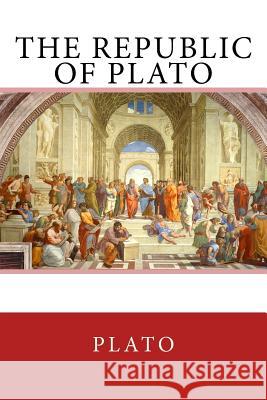
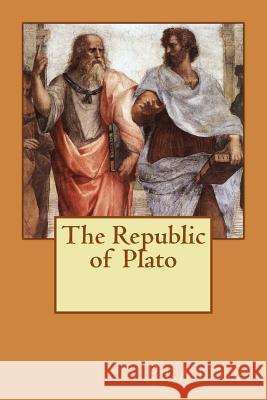
Complete digitally restored reprint(facsimile) of the original edition of 1908 (third edition) with excellent resolution and outstanding readability. Translated by Benjamin Jowett (1817-1893). The Layout is +30 % larger as the original. "The Republic" is Plato's best-known work, it has proven to be one of the world's most influential works of philosophy and political theory, both intellectually and historically. In it, Socrates along with various Athenians and foreigners discuss the meaning of justice and examine whether or not the just man is happier than the unjust man by considering a...
Complete digitally restored reprint(facsimile) of the original edition of 1908 (third edition) with excellent resolution and outstanding readability. ...
Complete digitally restored reprint(facsimile) of the original edition of 1908 (third edition) with excellent resolution and outstanding readability. Translated by Benjamin Jowett (1817-1893). The Layout is +30 % larger as the original. "The Republic" is Plato's best-known work, it has proven to be one of the world's most influential works of philosophy and political theory, both intellectually and historically. In it, Socrates along with various Athenians and foreigners discuss the meaning of justice and examine whether or not the just man is happier than the unjust man by considering a...
Complete digitally restored reprint(facsimile) of the original edition of 1908 (third edition) with excellent resolution and outstanding readability. ...
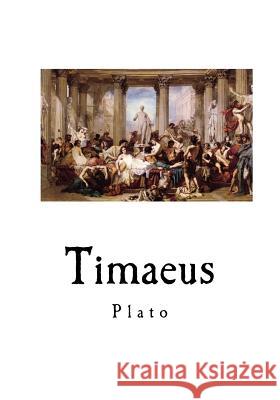
Timaeus is one of Plato's dialogues, mostly in the form of a long monologue given by the title character Timaeus of Locri, written c. 360 BC. The work puts forward speculation on the nature of the physical world and human beings and is followed by the dialogue Critias.
Of all the writings of Plato the Timaeus is the most obscure and repulsive to the modern reader, and has nevertheless had the greatest influence over the ancient and mediaeval world. The obscurity...
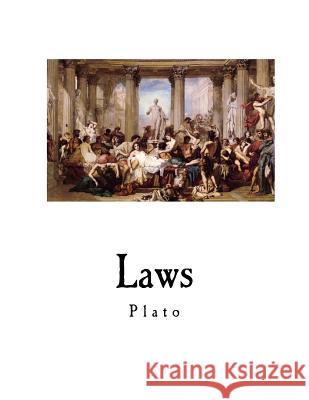
The Laws is Plato's last and longest dialogue. The conversation depicted in the work's twelve books begins with the question of who is given the credit for establishing a civilization's laws. Its musings on the ethics of government and law have established it as a classic of political philosophy alongside Plato's more widely read Republic.
The Laws are discussed by three representatives of Athens, Crete, and Sparta. The Athenian, as might be expected, is the protagonist...
This Dialogue begins abruptly with a question of Meno, who asks, 'whether virtue can be taught.' Socrates replies that he does not as yet know what virtue is, and has never known anyone who did. 'Then he cannot have met Gorgias when he was at Athens.' Yes, Socrates had met him, but he has a bad memory, and has forgotten what Gorgias said. Will Meno tell him his own notion, which is probably not very different from that of...
The Apology of Socrates by Plato, presents the speech of self-defence given by Socrates in his trial for impiety and corruption (399 BC) -- specifically against the charges of "corrupting the young, and by not believing in the gods in whom the city believes, but in other daimonia that are novel."
The Apology of Socrates is the dialogue that depicts the death of Socrates, and is one of the four works, along with Euthyphro, Phaedo, and Crito, through which Plato details...
Phaedrus - Plato - Translated with an introduction by Benjamin Jowett - The Phaedrus is closely connected with the Symposium, and may be regarded either as introducing or following it. The two Dialogues together contain the whole philosophy of Plato on the nature of love, which in the Republic and in the later writings of Plato is only introduced playfully or as a figure of speech. But in the Phaedrus and Symposium love and philosophy join hands, and one is an aspect of the other. The spiritual and emotional part is elevated into the ideal, to which in the Symposium mankind are described as...
Phaedrus - Plato - Translated with an introduction by Benjamin Jowett - The Phaedrus is closely connected with the Symposium, and may be regarded eith...
Symposium by Plato - Translated by Benjamin Jowett - The Symposium is a philosophical text by Plato dated c. 385-370 BC. It concerns itself at one level with the genesis, purpose and nature of love, and (in latter-day interpretations) is the origin of the concept of Platonic love. Of all the works of Plato the Symposium is the most perfect in form, and may be truly thought to contain more than any commentator has ever dreamed of; or, as Goethe said of one of his own writings, more than the author himself knew. For in philosophy as in prophecy glimpses of the future may often be conveyed in...
Symposium by Plato - Translated by Benjamin Jowett - The Symposium is a philosophical text by Plato dated c. 385-370 BC. It concerns itself at one lev...