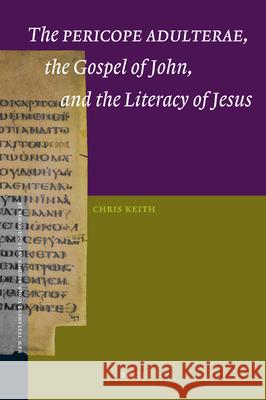
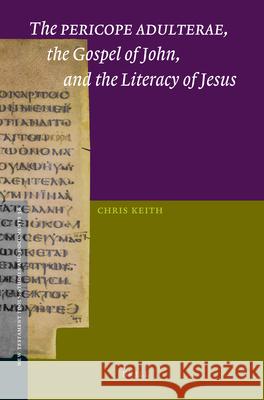
Although consistently overlooked or dismissed, John 8.6, 8 in the Pericope Adulterae is the only place in canonical or non-canonical Jesus tradition that portrays Jesus as writing. After establishing that John 8.6, 8 is indeed a claim that Jesus could write, this book offers a new interpretation and transmission history of the Pericope Adulterae. Not only did the pericope's interpolator place the story in John's Gospel in order to highlight the claim that Jesus could write, but he did so at John 7.53-8.11 as a result of carefully reading the Johannine narrative. The final...
Although consistently overlooked or dismissed, John 8.6, 8 in the Pericope Adulterae is the only place in canonical or non-canonical Jesus trad...
Criteria of authenticity, whose roots go back to before the pioneering work of Albert Schweitzer, have become a unifying feature of the so-called Third Quest for the Historical Jesus, finding a prominent and common place in the research of otherwise differing scholars. More recently, however, scholars from different methodological frameworks have expressed discontent with this approach to the historical Jesus. In the past five years, these expressions of discontent have reached a fever pitch.
The internationally renowned authors of this book examine the nature of this new debate and...
Criteria of authenticity, whose roots go back to before the pioneering work of Albert Schweitzer, have become a unifying feature of the so-called T...
Although consistently overlooked or dismissed, John 8.6, 8 in the Pericope Adulterae is the only place in canonical or non-canonical Jesus tradition that portrays Jesus as writing. After establishing that John 8.6, 8 is indeed a claim that Jesus could write, this book offers a new interpretation and transmission history of the Pericope Adulterae. Not only did the pericope's interpolator place the story in John's Gospel in order to highlight the claim that Jesus could write, but he did so at John 7.53-8.11 as a result of carefully reading the Johannine narrative. The final...
Although consistently overlooked or dismissed, John 8.6, 8 in the Pericope Adulterae is the only place in canonical or non-canonical Jesus trad...
Mark, Manuscripts, and Monotheism is organized into three parts: Mark's Gospel, Manuscripts and Textual Criticism, and Monotheism and Early Jesus-Devotion. With contributors hailing from several different countries, and including both senior and junior scholars, this volume contains essays penned in honor of Larry W. Hurtado by engaging and focusing upon these three major emphases in his scholarship. The result is not only a fitting tribute to one of the most influential New Testament scholars of present times, but also a welcome survey of current scholarship.
Mark, Manuscripts, and Monotheism is organized into three parts: Mark's Gospel, Manuscripts and Textual Criticism, and Monotheism and Early Jesus-D...
The use of Scripture in 1 Peter has been subject to much extensive analysis in the last thirty years. In Written to Serve Benjamin Sargent offers an up to date and comprehensive analysis of how 1 Pet 1.10-12 offers a 'hermeneutic, ' providing an insight into how Scripture is interpreted in the letter. Sargent also argues that the relation of 1.10-12 has been misunderstood. Rather than offering a Christological hermeneutic with a focus on the suffering and glories of Christ, Sargent asserts that the primary importance of 1.10-12 is its orientation of the prophetic witness towards the...
The use of Scripture in 1 Peter has been subject to much extensive analysis in the last thirty years. In Written to Serve Benjamin Sargent offe...
The divisions in the Corinthian church are catalogued by Paul in 1 Corinthians 1:12: "Each of you says, 'I follow Paul, ' or 'I follow Apollos, ' or 'I follow Cephas, ' or 'I follow Christ.'" White shows how these splits are found in the milieu of 1st-century Graeco-Roman education. By consulting relevant literary and epigraphic evidence, White develops a picture of ancient education throughout the Empire generally, and in Roman Corinth specifically. This serves as a backdrop to the situation in the Christian community, wherein some of the elite, educated members preferred Apollos to Paul...
The divisions in the Corinthian church are catalogued by Paul in 1 Corinthians 1:12: "Each of you says, 'I follow Paul, ' or 'I follow Apollos, ' o...
Turley begins by surveying the history of the interface between ritual studies and Pauline scholarship, identifying the scholarly gaps in both method and conclusions and a ritual theory adequate to address such gaps. The focus of the work is then on the two rituals that identified the Pauline communities: ritual washings and ritual meals. Turley explores Galatians and 1 Corinthians, two letters that present the richest spread of evidence pertinent to ritual theory.
By exploring Paul's reference to ritual washings and meals with a heuristic use of ritual theory, Turley concludes that...
Turley begins by surveying the history of the interface between ritual studies and Pauline scholarship, identifying the scholarly gaps in both meth...
Uzukwu, Gesila Nneka Gesila Nneka Uzukwu Chris Keith
This detailed exegetical study of Gal 3.28c in the light of 3.14-29 and 4.21-31 shows not only how integral this verse is to chapters 3 and 4 of the letter, but also that it is the key to understanding Paul's theological argument of promise in Galatians. Paul's use of the story of Abraham in 3.14-29 and of Sarah in 4.21-31 in light of God's promise to the patriarch and the matriarch in Genesis 17 have implications displays the joint role of Abraham and Sarah in bringing about the promise, and underscores the unity of the believers in Christ.
In light of this, Uzukwu examines...
This detailed exegetical study of Gal 3.28c in the light of 3.14-29 and 4.21-31 shows not only how integral this verse is to chapters 3 and 4 of th...
A neglected area of study of the letter to the Hebrews is the function of the Old Testament in the letter's logic. Compton addresses this neglect by looking at two other ideas that have themselves received too little attention, namely (1) the unique and fundamental semantic contribution of Hebrews' exposition (vis-a-vis its exhortation) and (2) the prominence of Ps 110 in the author's exposition. The conclusion becomes clear that Hebrews' exposition-its theological argument-turns, in large part, on successive inferences drawn from Ps 110:1 and 4.
Compton observes that the author uses...
A neglected area of study of the letter to the Hebrews is the function of the Old Testament in the letter's logic. Compton addresses this neglect b...
Carlos Raul Sosa Siliezar Carlos Raaul Sos Chris Keith
Sosa Siliezar investigates the presence and significance of creation imagery in the Gospel of John. He argues that John has intentionally included only a limited (albeit significant) number of instances of creation imagery and that he has positioned them carefully to highlight their significance.
Sosa Siliezar contends that the instances of creation imagery used in varying contexts function collectively in a threefold way that is consonant with John's overall argument. First, John uses them to portray Jesus in close relationship with his Father, existing apart from and prior to the...
Sosa Siliezar investigates the presence and significance of creation imagery in the Gospel of John. He argues that John has intentionally included ...