At a time when food is becoming increasingly scarce in many parts of the world and food prices are skyrocketing, no industry is more important than agriculture. Humans have been farming for thousands of years, and yet agriculture has undergone more fundamental changes in the past 80 years than in the previous several centuries. In 1900, 30 million American farmers tilled the soil or tended livestock; today there are fewer than 4.5 million farmers who feed a population four times larger than it was at the beginning of the century. Fifty years ago, the planet could not have sustained a...
At a time when food is becoming increasingly scarce in many parts of the world and food prices are skyrocketing, no industry is more important than...
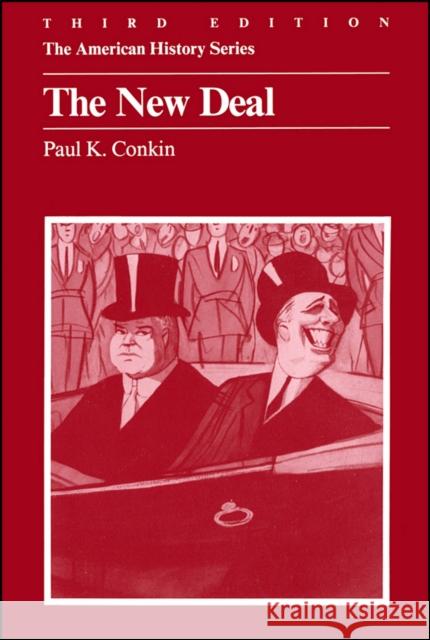
Demonstrating the intellectual excitement that is the practice of history at its best, Paul Conkin's The New Deal is still one of the best known titles in the very popular American History Series, edited by John Hope Franklin and A. S. Eisenstadt.
The New Deal is still the best succinct and coherent description of a chaotic period. It is an account of the major domestic policies adopted during the Roosevelt administration. It is also a rich portrait of Roosevelt the man and consummate politician, and the satellite figures around him. This highly interpretive text, with its spirited...
Demonstrating the intellectual excitement that is the practice of history at its best, Paul Conkin's The New Deal is still one of the best known ti...
The pace of human progress accelerated profoundly in the twentieth century, spawning revolutionary advances in medicine, agriculture, and industry. Between 1900 and 2000, the world's population quadrupled, and production and consumption of goods increased by a factor of twelve.
In The State of the Earth, award-winning historian Paul K. Conkin offers a balanced, nuanced, and ultimately hopeful assessment of the major environmental challenges that must be met after a century of torrid growth and development. Unlike many recent polemics that reduce serious environmental debates...
The pace of human progress accelerated profoundly in the twentieth century, spawning revolutionary advances in medicine, agriculture, and industry....
At a time when food is becoming increasingly scarce in many parts of the world and food prices are skyrocketing, no industry is more important than agriculture. Humans have been farming for thousands of years, and yet agriculture has undergone more fundamental changes in the past 80 years than in the previous several centuries. In 1900, 30 million American farmers tilled the soil or tended livestock; today there are fewer than 4.5 million farmers who feed a population four times larger than it was at the beginning of the century. Fifty years ago, the planet could not have sustained a...
At a time when food is becoming increasingly scarce in many parts of the world and food prices are skyrocketing, no industry is more important than...