Anna Tellwright and her younger sister live with their miserly father in a manufacturing town in the Potteries. He rules the household by fear and that, together with the local Weslyan Methodist Church gives Anna a joyless and narrow life. When Anna is 21 she inherits her mother's fortune but her father will not allow her to manage it and she has to beg him to release any money she needs. She becomes engaged to a member of the congregation, mainly to escape her father. She likes and respects him but later realises that she loves the son of one of her tenant manufacturers. Will Anna follow her...
Anna Tellwright and her younger sister live with their miserly father in a manufacturing town in the Potteries. He rules the household by fear and tha...
Edward Henry Machin (no longer known as Denry) is now aged 43 and although a successful businessman and head of a happy family, he is dissatisfied with his lot and wants a new challenge. A chance meeting in a local theatre presents him with an opportunity to build a theatre in London, in the area of Regent Street and Shaftesbury Avenue. He meets with various difficulties, which he overcomes in his usual way, a combination of hard work, various wiles and a pinch of luck. How he deals with a poetic author, and demanding actresses is told with the usual Bennett humour.
Edward Henry Machin (no longer known as Denry) is now aged 43 and although a successful businessman and head of a happy family, he is dissatisfied wit...
The novel charts the rise and rise of Edward Henry (Denry) Machin from the day he cheated to get into the local grammar school until he becomes the youngest mayor of his town in the Potteries. On the way he becomes involved in several amusing and audacious schemes which earns him the title of "The Card," a "character" who amuses those who witness his actions.
The novel charts the rise and rise of Edward Henry (Denry) Machin from the day he cheated to get into the local grammar school until he becomes the yo...
Arnold Bennett was a prolific British writer who penned dozens of works across all genres, from adventurous fiction to propaganda and nonfiction. He wrote plays like Judith and historical novels like Tales of the Five Towns.
Arnold Bennett was a prolific British writer who penned dozens of works across all genres, from adventurous fiction to propaganda and nonfiction. He w...
Arthur Prohack is a bureaucrat who relishes carrying out his duties with precision and accuracy. His exceedingly high expectations have earned him grudging respect -- and a measure of fear -- from his colleagues and underlings. When Prohack unexpectedly receives a windfall, his comfortable middle-class existence is turned upside down. Will he be able to adjust to his new status?
Arthur Prohack is a bureaucrat who relishes carrying out his duties with precision and accuracy. His exceedingly high expectations have earned him gru...
The story takes place in 1919-1920 and deals with the final year in the life of its main character, Henry Earlforward, a miser, who keeps a second-hand bookshop in the Clerkenwell area of London. Henry marries Violet Arb, a widow who keeps a neighbouring shop, and who sees in Henry a financially secure future. Henry's parsimony drives them into an increasingly wretched existence. Their lives are contrasted to that of their maid servant Elsie Sprickett and it is she, despite her extreme poverty, who brings life and a future to the bittersweet tale.
The story takes place in 1919-1920 and deals with the final year in the life of its main character, Henry Earlforward, a miser, who keeps a second-han...
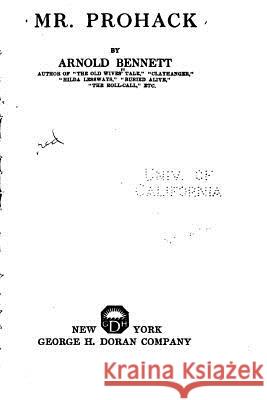
Mr. Prohack by Arnold Bennett. This book is a reproduction of the original book published in 1922 and may have some imperfections such as marks or hand-written notes.
Mr. Prohack by Arnold Bennett. This book is a reproduction of the original book published in 1922 and may have some imperfections such as marks or han...
In the book, Bennett addressed the large and growing number of white-collar workers that had accumulated since the advent of the Industrial Revolution. In his view, these workers put in eight hours a day, 40 hours a week, at jobs they did not enjoy, and at worst hated. They worked to make a living, but their daily existence consisted of waking up, getting ready for work, working as little as possible during the work day, going home, unwinding, going to sleep, and repeating the process the next day. In short, he didn't believe they were really living. Bennett addressed this problem by urging...
In the book, Bennett addressed the large and growing number of white-collar workers that had accumulated since the advent of the Industrial Revolution...