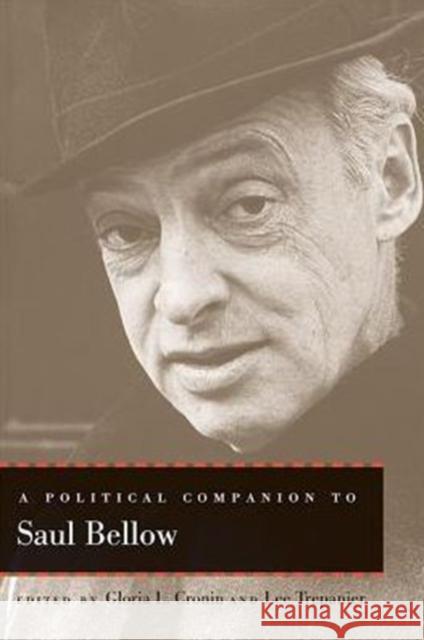
Saul Bellow is one of the twentieth century's most influential, respected, and honored writers. His novels The Adventures of Augie March, Herzog, and Mr. Sammler's Planet won the National Book Award, and Humboldt's Gift was awarded the 1976 Pulitzer Prize for fiction. In addition, his plays garnered popular and critical acclaim, and some were produced on Broadway. Known for his insights into life in a post-Holocaust world, Bellow's explorations of modernity, Jewish identity, and the relationship between art and society have resonated with his readers, but...
Saul Bellow is one of the twentieth century's most influential, respected, and honored writers. His novels The Adventures of Augie March,
Since the Financial Crisis of 2008, there has been and continues to be a debate about the proper role of the free market in the United States and beyond. On one side there are those who defend the free market as a method to provide both wealth and democratic legitimacy; while on the other side are thinkers who reject the orthodoxy of the free market and call for a greater role of government in society to correct its failures. But what is needed in this debate is a return to the vantage point of the human condition to better understand both the free market and our role in it. The Free Market...
Since the Financial Crisis of 2008, there has been and continues to be a debate about the proper role of the free market in the United States and beyo...
Recognized as one of the greatest novelists of all-time, Fyodor Dostoevsky continues to inspire and instigate questions about religion, philosophy, and literature. However, there has been a neglect looking at his political thought: its philosophical and religious foundations, its role in nineteenth-century Europe, and its relevance for us today. Dostoevsky's Political Thought explores Dostoevsky's political thought in his fictional and nonfictional works with contributions from scholars of political science, philosophy, history, and Russian Studies. From a variety of perspectives, these...
Recognized as one of the greatest novelists of all-time, Fyodor Dostoevsky continues to inspire and instigate questions about religion, philosophy, an...
Most statements today about higher education begin with the assumption that it should be relevant. That it should be relevant, however, does not settle the matter. The significance of relevance depends on the power of something else that is more fundamental. Relevance may be a true standard of judgment, but it does not stand by itself. Assuming higher education should be relevant, the question emerges, relevant to what? Why? How? At what costs? And, relevant in what sense? These are some of the central questions animating this study. The Relevance of Higher Education: Exploring a Contested...
Most statements today about higher education begin with the assumption that it should be relevant. That it should be relevant, however, does not settl...
In Subjectivity, sixteen leading scholars examine the turn to the subject in modern philosophy and consider its historical antecedents in ancient and medieval thought. Some critics of modernity reject the turn to the subject as a specifically modern error, arguing that it logically leads to nihilism and moral relativism by divorcing the human mind from objective reality. Yet, some important thinkers of the last half-century--including Leo Strauss, Eric Voegelin, John Finnis, and Bernard Lonergan--consider a subjective starting point and claim to find a similar position in ancient and medieval...
In Subjectivity, sixteen leading scholars examine the turn to the subject in modern philosophy and consider its historical antecedents in ancient and ...