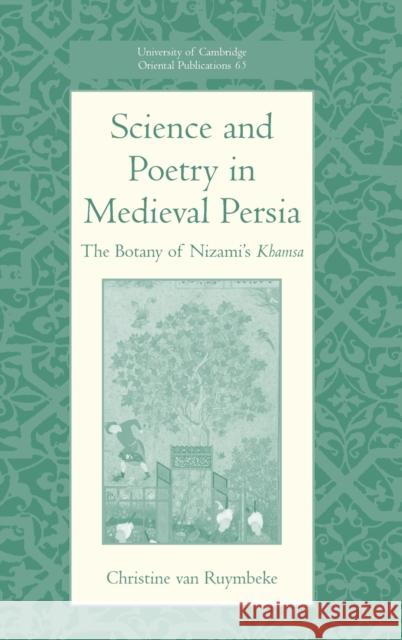
Nizami Ganjavi is one of the foremost figures in Persian poetry, living in Azerbaijan in the second half of the twelfth century. One of the oldest Western poets in Persian literature, he is acclaimed for his five masnavis which are assembled to form the Khamsa (Quintet). His reputation is that of a difficult and refined poet, who introduced into his verse vocabulary, expressions and allusions to the then-known sciences. This study considers all his verses containing allusions to trees and their fruit. The scientific contents of these allusions are then checked with the help of Arabic and...
Nizami Ganjavi is one of the foremost figures in Persian poetry, living in Azerbaijan in the second half of the twelfth century. One of the oldest Wes...
This splendid work consists of thirteen essays by eminent scholars, each focusing on different aspects of the Khamsa, which is a collection of five long poems written by the Persian poet Nizami of Ganja (1141-1209). Its heroes, Khosrow and Shirin, Leili and Majnun, Iskandar, have become household names all over the Islamic world. This volume reflects topics such as mysticism, art history, comparative literature, science, and philosophy. It constitutes a significant development in the field of Nizami-studies, and more general, of Persian literature. It shows how classical Greek knowledge...
This splendid work consists of thirteen essays by eminent scholars, each focusing on different aspects of the Khamsa, which is a collection of five lo...
This volume of essays is based on a conference held in July 2009 at Trinity College, Cambridge to celebrate the bicentenary of the birth of Edward FitzGerald (1809) and the 150th anniversary of the first publication of his Rubaiyat of Omar Khayyam (1859). The Rubaiyat, loosely based on the verses attributed to the eleventh-century Persian writer, Omar Khayyam, has become one of the most widely known poems in the world, republished virtually every year from 1879 (the year of FitzGerald s fourth edition) to the present day, and translated into over eighty different languages. And yet, with a...
This volume of essays is based on a conference held in July 2009 at Trinity College, Cambridge to celebrate the bicentenary of the birth of Edward ...
This volume of essays is based on a conference held in July 2009 at Trinity College, Cambridge to celebrate the bicentenary of the birth of Edward FitzGerald (1809) and the 150th anniversary of the first publication of his Rubaiyat of Omar Khayyam (1859). The Rubaiyat, loosely based on the verses attributed to the eleventh-century Persian writer, Omar Khayyam, has become one of the most widely known poems in the world, republished virtually every year from 1879 (the year of FitzGerald s fourth edition) to the present day, and translated into over eighty different languages. And yet, with a...
This volume of essays is based on a conference held in July 2009 at Trinity College, Cambridge to celebrate the bicentenary of the birth of Edward ...