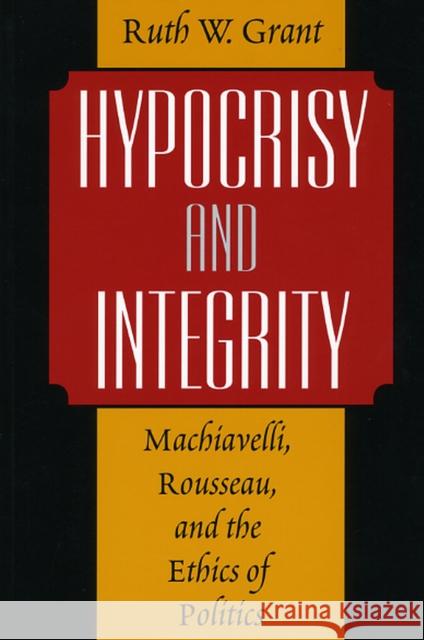
Questioning the usual judgements of political ethics, Ruth W. Grant argues that hypocrisy can actually be constructive while strictly principled behavior can be destructive. "Hypocrisy and Integrity" offers a new conceptual framework that clarifies the differences between idealism and fanaticism while it uncovers the moral limits of compromise. "Exciting and provocative. . . . Grant's work is to be highly recommended, offering a fresh reading of Rousseau and Machiavelli as well as presenting a penetrating analysis of hypocrisy and integrity." Ronald J. Terchek, "American Political Science...
Questioning the usual judgements of political ethics, Ruth W. Grant argues that hypocrisy can actually be constructive while strictly principled behav...
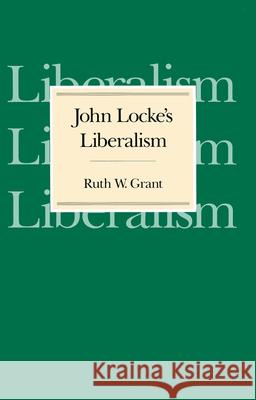
In this work, Ruth W. Grant presents a new approach to John Locke's familiar works. Taking the unusual step of relating Locke's "Two Treatises" to his "Essay Concerning Human Understanding," Grant establishes the unity and coherence of Locke's political arguments. She analyzes the "Two Treatises" as a systematic demonstration of liberal principles of right and power and grounds it in the epistemology set forth in the "Essay."
In this work, Ruth W. Grant presents a new approach to John Locke's familiar works. Taking the unusual step of relating Locke's "Two Treatises" to his...