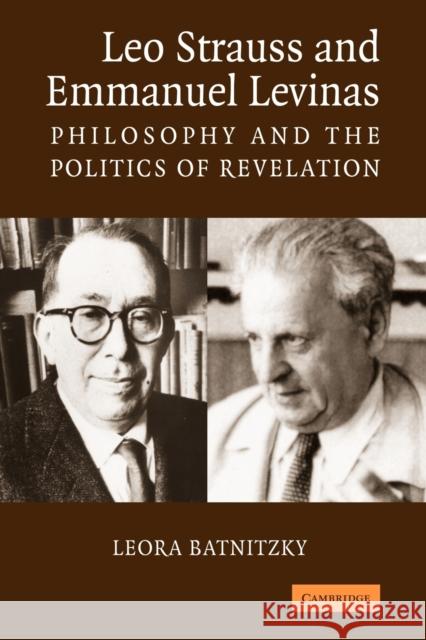
Leo Strauss and Emmanuel Levinas, two twentieth-century Jewish philosophers and two extremely provocative thinkers whose reputations have grown considerably, are rarely studied together. This is due to the disparate interests of many of their intellectual heirs. Strauss has influenced political theorists and policy makers on the right while Levinas has been championed in the humanities by different cadres associated with postmodernist thought. In Leo Strauss and Emmanuel Levinas: Philosophy and the Politics of Revelation, Leora Batnitzky brings together these two seemingly incongruous...
Leo Strauss and Emmanuel Levinas, two twentieth-century Jewish philosophers and two extremely provocative thinkers whose reputations have grown consid...
Leo Strauss and Emmanuel Levinas, two twentieth-century Jewish philosophers and two extremely provocative thinkers whose reputations have grown considerably, are rarely studied together. This is due to the disparate interests of many of their intellectual heirs. Strauss has influenced political theorists and policy makers on the right while Levinas has been championed in the humanities by different cadres associated with postmodernist thought. In Leo Strauss and Emmanuel Levinas: Philosophy and the Politics of Revelation, first published in 2006, Leora Batnitzky brings together these two...
Leo Strauss and Emmanuel Levinas, two twentieth-century Jewish philosophers and two extremely provocative thinkers whose reputations have grown consid...
Although Franz Rosenzweig is arguably the most important Jewish philosopher of the twentieth century, his thought remains little understood. Here, Leora Batnitzky argues that Rosenzweig's redirection of German-Jewish ethical monotheism anticipates and challenges contemporary trends in religious studies, ethics, philosophy, anthropology, theology, and biblical studies.
This text, which captures the hermeneutical movement of Rosenzweig's corpus, is the first to consider the full import of the cultural criticism articulated in his writings on the modern meanings of art, language,...
Although Franz Rosenzweig is arguably the most important Jewish philosopher of the twentieth century, his thought remains little understood. Here, ...
Biblical in origin, the expression "eclipse of God" refers to the Jewish concept of hester panim, the act of God concealing his face as a way of punishing his disobedient subjects. Though this idea is deeply troubling for many people, in this book Martin Buber uses the expression hopefully--for a hiding God is also a God who can be found.
First published in 1952, Eclipse of God is a collection of nine essays concerning the relationship between religion and philosophy. The book features Buber's critique of the thematically interconnected--yet diverse--perspectives of...
Biblical in origin, the expression "eclipse of God" refers to the Jewish concept of hester panim, the act of God concealing his face as a wa...