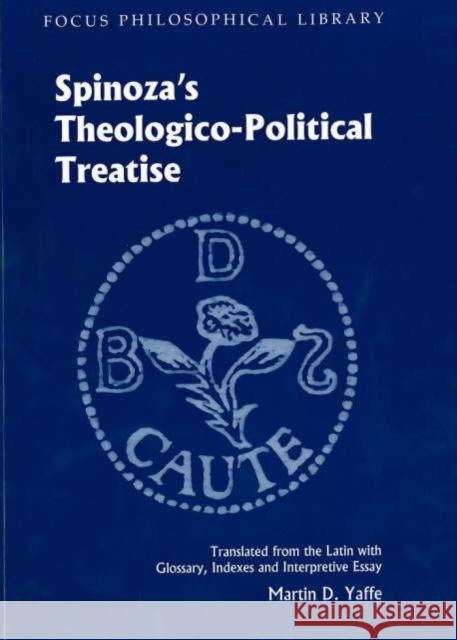
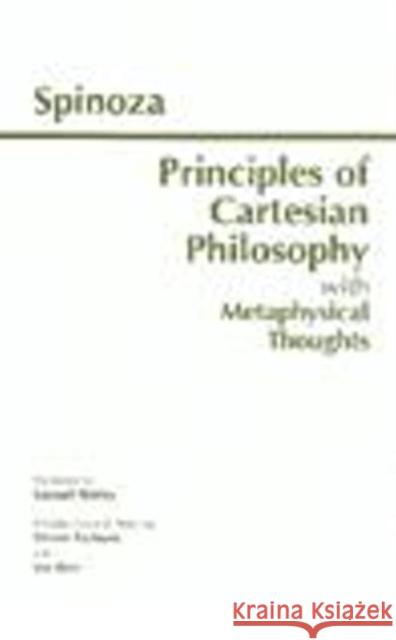
A complete translation in English of this modern text, with substantive apparatus to allow the student and serious reader to grapple in a meaningful way with this seminal text. The text includes ample footnotes, Spinoza s annotations, an interpretative essay, glossary and other indices.
Focus Philosophical Library translations are close to and are non-interpretative of the original text, with the notes and a glossary intending to provide the reader with some sense of the terms and the concepts as they were understood by Spinoza s immediate audience.
This is the hardcover edition."
A complete translation in English of this modern text, with substantive apparatus to allow the student and serious reader to grapple in a meaningful w...
In the genre of Christian philosophers, Spinoza presents a geometric argument for the necessary existence of God as the one absolute substance underlying all other substance. From the necessity of God's existance, he derives the laws of existence, those of nature, and the ethical principles animating human conduct. In this sweeping volume that covers a wide range of topics from metaphysics, epistemology, and theology, Spinoza addresses the key concepts of freedom, the existence of evil, and the ultimate purpose of humanity.
In the genre of Christian philosophers, Spinoza presents a geometric argument for the necessary existence of God as the one absolute substance underly...
Samuel Shirley's splendid new translation, with critical annotation reflecting research of the last half-century, is the only edition of the complete text of Spinoza's correspondence available in English. An historical-philosophical Introduction, detailed annotation, a chronology, and a bibliography are also included.
Samuel Shirley's splendid new translation, with critical annotation reflecting research of the last half-century, is the only edition of the comple...
With meticulous scholarship and an accurate, highly readable translation, this volume sheds light not only on Spinoza's debt to Descartes but also on the development of Spinoza's own thought.
Appearing for the first time in English translation, Lodewijk Meyer's inaugural dissertation on matter (1683)--relevant for its comments on Descartes, Spinoza, and other thinkers of the time--is appended with notes and a short commentary. Cross-references to Descartes's "Principles of Philosophy" are provided in an index, and there is an extensive bibliography.
With meticulous scholarship and an accurate, highly readable translation, this volume sheds light not only on Spinoza's debt to Descartes but also ...
Designed to facilitate a thoughtful and informed reading of Spinoza's "Ethics," this anthology provides the "Ethics," related writings, and two valuable appendices: List of Propositions from the "Ethics," which helps readers to trace the development of key themes; and Citations in Proofs, a list of all the propositions, corollaries, and scholia in the Ethics, together with all the definitions, axioms, propositions, corollaries, and scholia to which Spinoza refers in the proofs--thus, readers can locate, for a given item, each instance where Spinoza refers to it.
Designed to facilitate a thoughtful and informed reading of Spinoza's "Ethics," this anthology provides the "Ethics," related writings, and two val...
"The Political Treatise," Spinoza's final work, is a largely theoretical inquiry into the fundamental principles of political philosophy. This edition offers an exceptional translation by Samuel Shirley and a prefatory essay by Douglas Den Uyl that discusses why the "Political Treatise" deserves the attention of contemporary scholars. Steven Barbone and Lee Rice provide ample notes, a substantial bibliography, complete indexes of names and terms, and a comprehensive general introduction, which considers the evolution of Spinoza's political thought in the context of the political and...
"The Political Treatise," Spinoza's final work, is a largely theoretical inquiry into the fundamental principles of political philosophy. This edit...
With meticulous scholarship and an accurate, highly readable translation, this volume sheds light not only on Spinoza's debt to Descartes but also on the development of Spinoza's own thought.
Appearing for the first time in English translation, Lodewijk Meyer's inaugural dissertation on matter (1683)--relevant for its comments on Descartes, Spinoza, and other thinkers of the time--is appended with notes and a short commentary. Cross-references to Descartes's "Principles of Philosophy" are provided in an index, and there is an extensive bibliography.
With meticulous scholarship and an accurate, highly readable translation, this volume sheds light not only on Spinoza's debt to Descartes but also ...
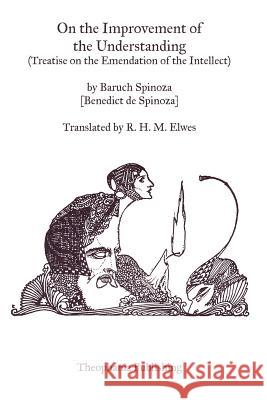
Thank you for checking out this book by Theophania Publishing. We appreciate your business and look forward to serving you soon. We have thousands of titles available, and we invite you to search for us by name, contact us via our website, or download our most recent catalogues. This Treatise on the Emendation of the Intellect etc., which we give you here, kind reader, in its unfinished, that is, defective state, was written by the author many years ago now. He always intended to finish it. But hindered by other occupations, and finally snatched away by death, he was unable to bring it to the...
Thank you for checking out this book by Theophania Publishing. We appreciate your business and look forward to serving you soon. We have thousands of ...
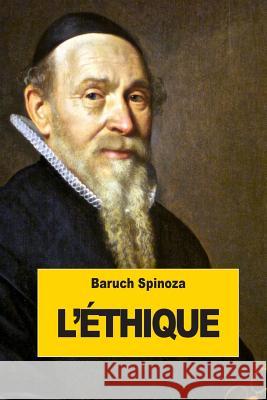
Dans ce livre, Spinoza adopte une methode de demonstration deductive, calquee sur le mode de la demonstration mathematique, dans laquelle des propositions, demonstrations, scolies et lemmes succedent aux definitions, axiomes et postulats. Si ce procede d'exposition en fonction d'un ordre geometrique a pour but de conferer aux raisonnements developpes dans l'ouvrage la plus grande rigueur possible. Le livre aborde successivement les thematiques de Dieu, de l'ame, des passions (ou affects), du conatus, de la servitude de l'homme, et enfin de la possibilite et des moyens pour l'homme d'acceder a...
Dans ce livre, Spinoza adopte une methode de demonstration deductive, calquee sur le mode de la demonstration mathematique, dans laquelle des proposit...