According to the European chronicles, at the time of contact, the Greater Antilles were inhabited by the Tainos or Arawak Indians, who were organized in hierarchical societies. Since its inception Carribean archaeology has used population as an important variable in explaining many social, political, and economic processes such as migration, changes in subsistence systems, and the development of institutionalized social stratification. In Caribbean Paleodemography, L. Antonio Curet argues that population has been used casually by Caribbean archaeologists and proposes more rigorous and...
According to the European chronicles, at the time of contact, the Greater Antilles were inhabited by the Tainos or Arawak Indians, who were organized ...
Provides a politically and historically informed review of Cuban archaeology, from both American and Cuban perspectives.
Many Americans are aware of the political, economic, and personal impacts of the U.S. embargo on Cuba. But the communication blockade between scholars has also affected the historical course of academic disciplines and research in general. With the easing of restrictions in the 1990s, academics are now freer to conduct research in Cuba, and the Cuban government has been more receptive to collaborative projects. This volume provides a forum for the principal...
Provides a politically and historically informed review of Cuban archaeology, from both American and Cuban perspectives.
Important information on prehistoric island populations and migrations.
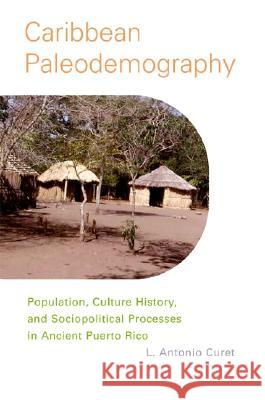
According to the European chronicles, at the time of contact, the Greater Antilles were inhabited by the Taino or Arawak Indians, who were organized in hierarchical societies. Since its inception Caribbean archaeology has used population as an important variable in explaining many social, political, and economic processes such as migration, changes in subsistence systems, and the development of institutionalized social stratification.
In Caribbean Paleodemography, L. Antonio Curet argues that...
Important information on prehistoric island populations and migrations.
According to the European chronicles, at the time of contact, ...
Provides a politically and historically informed review of Cuban archaeology, from both American and Cuban perspectives.
Many Americans are aware of the political, economic, and personal impacts of the U.S. embargo on Cuba. But the communication blockade between scholars has also affected the historical course of academic disciplines and research in general. With the easing of restrictions in the 1990s, academics are now freer to conduct research in Cuba, and the Cuban government has been more receptive to collaborative projects. This volume provides a forum for the principal...
Provides a politically and historically informed review of Cuban archaeology, from both American and Cuban perspectives.
This innovative volume builds on dialogues opened in recent years between Cuban archaeologists, whose work has long been carried out behind closed doors, and their international colleagues. The chapters included herein span a wide range of subjects across the full chronological spectrum. Most were written by emerging Cuban professionals who are breaking new ground; a few were penned by long-time leaders in the field. Issues addressed by the 17 contributors represented in this collection include the long-term cultural and intellectual links between Florida and Cuba, which influence shared...
This innovative volume builds on dialogues opened in recent years between Cuban archaeologists, whose work has long been carried out behind closed doo...
This innovative volume builds on dialogues opened in recent years between Cuban archaeologists, whose work has long been carried out behind closed doors, and their international colleagues. The chapters included herein span a wide range of subjects across the full chronological spectrum. Thus this volume makes a crucial contribution to the field of archaeology on many fronts, not the least of which is the sharing of information across the blockade.
This innovative volume builds on dialogues opened in recent years between Cuban archaeologists, whose work has long been carried out behind closed ...
When originally published in German in 1924, this volume was hailed as the first modern, comprehensive archaeological overview of an emerging area of the world. Yes, the Caribbean islands had long been known and owned, occupied, or traded among by the economically advanced nations of the world. However, the original inhabitants as well as their artifacts, languages, and culture had been treated by explorers and entrepreneurs alike as either slaves or hindrances to progress, and were used or eliminated. There was no publication that treated seriously the region and the peoples until this work....
When originally published in German in 1924, this volume was hailed as the first modern, comprehensive archaeological overview of an emerging area of ...
A long sequence of social, cultural, and political processes characterizes an ever-dynamic Caribbean history. The Caribbean Basin is home to numerous linguistic and cultural traditions and fluid interactions that often map imperfectly onto former colonial and national traditions. Although much of this contact occurred within the confines of local cultural communities, regions, or islands, they nevertheless also include exchanges between islands, and in some cases, with the surrounding continents. recent research in the pragmatics of seafaring and trade suggests that in many cases...
A long sequence of social, cultural, and political processes characterizes an ever-dynamic Caribbean history. The Caribbean Basin is home to numerous ...