Theory for Education provides a concise and clear introduction to key contemporary theorists, including their lives, major works and ideas. Written for the student in need of a quick introduction or for the scholar brushing up on details, this new volume in the theory4 series presents major thinkers whose work and ideas have shaped critical thinking in our time. Greg Dimitriadis and George Kamberelis underscore the particular relevance of these thinkers for the field of education - their work on education, how others in education have used them and possible future...
Theory for Education provides a concise and clear introduction to key contemporary theorists, including their lives, major works and ideas...
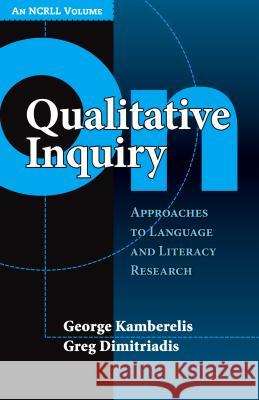
In this seminal work, the authors provide the first systematic exploration of the philosophical foundations and the historical development of qualitative inquiry. Thorough yet accessible, this volume is an indispensable tool for language and literacy researchers--novices and experts alike. Includes a broad introduction to prominent theorists and researchers, including Dell Hymes, Shirley Brice Heath, Courtney Cazden Ruth Behar, Norman Denzin, and Patti Lather.
In this seminal work, the authors provide the first systematic exploration of the philosophical foundations and the historical development of qualitat...
Carol Brennan Jenkins Altfillisch Earle Alice George Kamberelis
This timely book explores the debate about how best to engage children in the writing of nonfiction and suggests many instructional strategies for K-6 classrooms. Using transcripts and descriptions of children's actual writing practices, the authors show that children willingly embrace nonfiction writing when the genre is given an important place in the classroom.
This timely book explores the debate about how best to engage children in the writing of nonfiction and suggests many instructional strategies for K-6...
Focus Groups: From Structured Interviews to Collective Conversations is a conceptual and practical introduction to focus group. As the title indicates, focus groups traditionally encompass a wide range of discursive practices. These span from formal structured interviews with particular people assembled around clearly delimited topics to less formal, open-ended conversations with large and small groups that can unfold in myriad and unpredictable ways. Additionally, focus groups can and have served many overlapping purposes-from the pedagogical, to the political, to the traditionally...
Focus Groups: From Structured Interviews to Collective Conversations is a conceptual and practical introduction to focus group. As the title indicates...