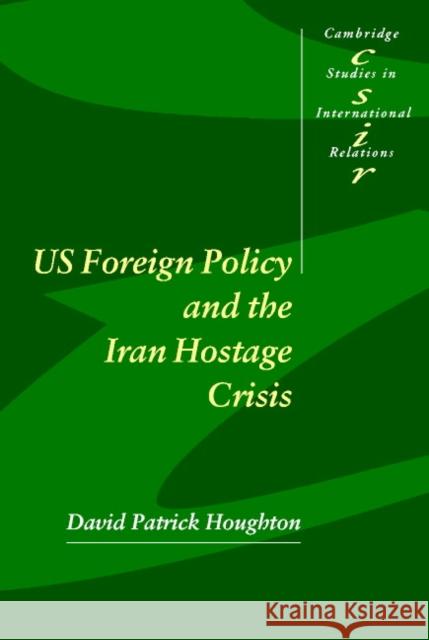
Why did Iranian students seize the American embassy in Tehran in 1979? Why did the Carter administration launch a rescue mission, and why did it fail so spectacularly? This book answers these and other puzzles using an analogical reasoning approach that highlights the role of historical analogies in decision making. Using interviews with key decision makers on both sides, Houghton provides an original analysis of one of the United States' greatest foreign policy disasters of recent years. The book will interest students and scholars of foreign policy analysis and international relations.
Why did Iranian students seize the American embassy in Tehran in 1979? Why did the Carter administration launch a rescue mission, and why did it fail ...
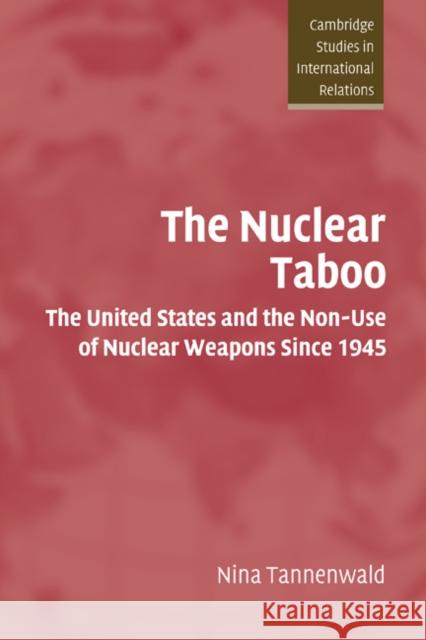
Why have nuclear weapons not been used since Hiroshima and Nagasaki in 1945? Nina Tannenwald disputes the conventional answer of 'deterrence' as incomplete. She argues in favour of a 'nuclear taboo' - a widespread inhibition on using nuclear weapons - which has arisen in global politics. Drawing on newly-released archival sources, Tannenwald traces the rise of the nuclear taboo, forces that produced it, and its influence, particularly on US leaders. She analyzes four critical instances where US leaders considered using nuclear weapons (Japan 1945, the Korean War, the Vietnam War and the Gulf...
Why have nuclear weapons not been used since Hiroshima and Nagasaki in 1945? Nina Tannenwald disputes the conventional answer of 'deterrence' as incom...
Susan Sell's book reveals how power in international politics is increasingly exercised by private interests rather than governments. In 1994 the World Trade Organization (WTO) adopted the Agreement in Trade-Related Aspects of Intellectual Property Rights (TRIPS), which dictated to states how they should regulate the protection of intellectual property. This book argues that TRIPS resulted from lobbying by powerful multinational corporations who wished to mould international law to protect their markets.
Susan Sell's book reveals how power in international politics is increasingly exercised by private interests rather than governments. In 1994 the Worl...
Paul Keal examines the historical role of international law and political theory in justifying the dispossession of indigenous peoples as part of the expansion of international society. Paradoxically, he argues, law and political theory can now form the basis of the recovery of indigenous rights. Arguing for the recognition of indigenous peoples as "peoples" with the right of self-determination in constitutional and international law, Keal questions the moral legitimacy of international society and examines concepts of collective guilt and responsibility.
Paul Keal examines the historical role of international law and political theory in justifying the dispossession of indigenous peoples as part of the ...
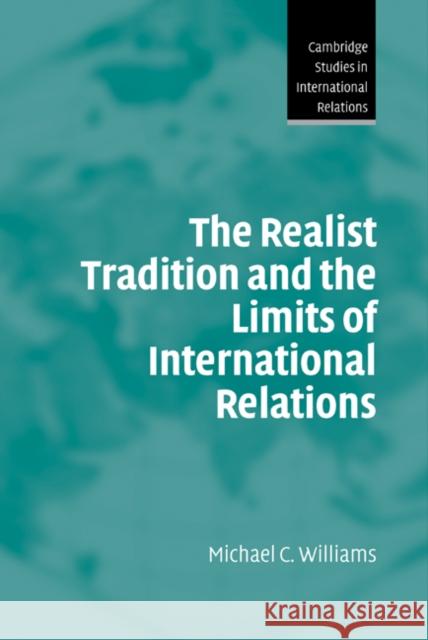
Although thinkers such as Thucydides, Rousseau and Hobbes are considered central to the realist tradition, Michael Williams re-evaluates their positions. Arguing that such philosophers were not concerned with methodological issues of rationality and anarchy, as commonly interpreted, Williams asserts that they wanted to establish political practices for leaders which would ensure order. His original interpretation of major thinkers will interest scholars of international relations and the history of ideas.
Although thinkers such as Thucydides, Rousseau and Hobbes are considered central to the realist tradition, Michael Williams re-evaluates their positio...
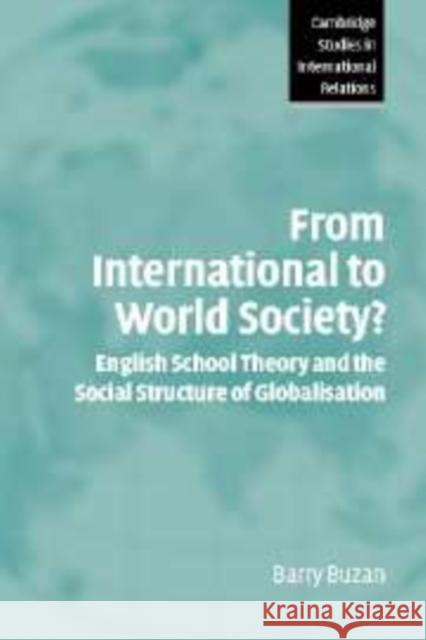
How is the concept of society understood on a global scale, since members are not individuals, but states, firms, NGOs and nations? Barry Buzan offers an original contribution to the "English School" theory. His study establishes a new theoretical framework emphasizing social structure that can be used to address globalization as complex political interplay among state and non-state actors.
How is the concept of society understood on a global scale, since members are not individuals, but states, firms, NGOs and nations? Barry Buzan offers...
Politics and law appear deeply entwined in contemporary international relations. Leading scholars accordingly advance a new perspective on the politics of international law in this volume. They redefine the nature of politics and demonstrate how modern politics has conditioned the nature of international law. This new perspective is illustrated through case studies of the use of force, climate change, landmines, migrant rights, the International Criminal Court, the Kosovo bombing campaign, international financial institutions, and global governance.
Politics and law appear deeply entwined in contemporary international relations. Leading scholars accordingly advance a new perspective on the politic...
Classical political theorists such as Thucydides, Kant, Rousseau, Smith, Hegel, Grotius, Mill, Locke and Clausewitz are often employed to explain and justify contemporary international politics and are seen to constitute the different schools of thought in the discipline. However, traditional interpretations frequently ignore the intellectual and historical context in which these thinkers were writing as well as the lineages through which they came to be appropriated in International Relations. This collection of essays provides alternative interpretations sensitive to these political and...
Classical political theorists such as Thucydides, Kant, Rousseau, Smith, Hegel, Grotius, Mill, Locke and Clausewitz are often employed to explain and ...
Maja Zehfuss critiques constructivist theories of international relations (currently considered to be at the cutting edge of the discipline) and finds them wanting and even politically dangerous. Zehfuss uses Germany's first shift toward using its military abroad after the end of the Cold War to illustrate why constructivism does not work and how it leads to particular analytical outcomes and forecloses others. She argues that scholars are limiting their abilities to act responsibly in international relations by looking towards constructivism as the future.
Maja Zehfuss critiques constructivist theories of international relations (currently considered to be at the cutting edge of the discipline) and finds...
It is generally argued that globalization has seriously limited the state's capacity to govern domestically. This book questions the thesis that the state's role in promoting social protection and wealth creation has been restricted. Covering a range of areas of state activity and political issues in developing and developed countries, the contributors explore the impact of global interdependence. They argue that globalization can enable as well as constrain, and that the effects will depend on the character of a country's domestic institutions.
It is generally argued that globalization has seriously limited the state's capacity to govern domestically. This book questions the thesis that the s...