Geospatial engineering capabilities have experienced significant improvements due to organizational changes, technological advancements, and emerging best practices. Geospatial engineering leverages ever-finer temporal and spatial resolutions from additional sensors and platforms that allow increased volumes and more complex data. New methods and technologies provide additional utility and the ability to work effectively within a broad pool of partners and allies. Army Tactics, Techniques, and Procedures (ATTP) 3-34.80 describes doctrine for geospatial engineering operations at all echelons....
Geospatial engineering capabilities have experienced significant improvements due to organizational changes, technological advancements, and emerging ...
FM 3-0 is one of the Army's two capstone doctrinal publications; the other is FM 1, The Army. FM 3-0 presents overarching doctrinal guidance and direction for conducting operations. The eight chapters that make up this edition of Operations constitute the Army's view of how it conducts prompt and sustained operations on land and sets the foundation for developing the other fundamentals and tactics, techniques, and procedures detailed in subordinate field manuals. FM 3-0 also provides operational guidance for commanders and trainers at all echelons and forms the foundation for Army Education...
FM 3-0 is one of the Army's two capstone doctrinal publications; the other is FM 1, The Army. FM 3-0 presents overarching doctrinal guidance and direc...
The six chapters and its associated ten appendixes of this edition of field manual (FM) 5-0, The Operations Process, constitute the Army's view on planning, preparing, executing, and assessing operations. Together with FM 6-0, Mission Command: Command and Control of Army Forces, this manual provides the Army with a common philosophy and language for the exercise of command and control throughout the conduct of operations. This version of FM 5-0 increases the scope of the manual over previous versions from strictly a manual on planning and orders production to a manual that addresses all...
The six chapters and its associated ten appendixes of this edition of field manual (FM) 5-0, The Operations Process, constitute the Army's view on pla...
Doctrine provides a military organization with a common philosophy, a language, a purpose, and unity of effort. Tactics is the art and science of employing all available means to win battles and engagements. Specifically, it comprises the actions taken by a commander to arrange units and activities in relation to each other and the enemy. This Field Manual (FM) 3-90 focuses on the tactics used to employ available means to win in combat. Those tactics require judgment in application. The ability to seize and secure terrain, with its populations and productive capacity, distinguishes land...
Doctrine provides a military organization with a common philosophy, a language, a purpose, and unity of effort. Tactics is the art and science of empl...
This Graphic Training Aid is about the culture of Iran. Topics include: Introduction and Geography; History; Iranian Cultural Beliefs; Customs and Engaging Iranians; Strategic Culture; and Structures and Institutions covering: Political; Military; Economy; Social; Infrastructure; Information; Local Measures; Calendar and Holidays; and further reading. Included is a Primer: Cross Cultural Competence; Fundamentals; Cultural Awareness; Cultural Knowledge; and Cultural-General Concepts.
This Graphic Training Aid is about the culture of Iran. Topics include: Introduction and Geography; History; Iranian Cultural Beliefs; Customs and Eng...
This manual contains procedures, techniques, and expedients for the instruction of the soldier in the assembly, use, detection, and removal of booby-traps in combat.
This manual contains procedures, techniques, and expedients for the instruction of the soldier in the assembly, use, detection, and removal of booby-t...
Field Manual (FM) 3-05.130, Army Special Operations Forces Unconventional Warfare, establishes keystone doctrine for Army special operations forces (ARSOF) operations in unconventional warfare (UW). It is based on lessons learned from both historical and contemporary UW operations. It is also based on existing, long-standing Army Special Forces (SF) UW doctrine; recently developed doctrine, such as counterinsurgency (COIN); and emerging affiliated concepts, such as irregular warfare (IW).
Field Manual (FM) 3-05.130, Army Special Operations Forces Unconventional Warfare, establishes keystone doctrine for Army special operations forces (A...
This field manual provides information needed to train and equip snipers and to aid them in their missions and operations. It is intended for use by commanders, staffs, trainers, snipers, and soldiers at training posts, Army schools, and units. This manual is organized as a reference for snipers and leads the trainer through the material needed to conduct sniper training. Subjects include equipment, weapon capabilities, fundamentals of marksmanship and ballistics, field skills, mission planning, and skill sustainment.
This field manual provides information needed to train and equip snipers and to aid them in their missions and operations. It is intended for use by c...
This manual provides guidance in Special Forces and unconventional warfare operations for commanders and staffs at all levels. The basic concepts of unconventional warfare are presented in a manner designed to acquaint the reader with Special Forces organization, concepts, and methods of operations to fulfill the Army's responsibility for the conduct of unconventional warfare.
This manual provides guidance in Special Forces and unconventional warfare operations for commanders and staffs at all levels. The basic concepts of u...
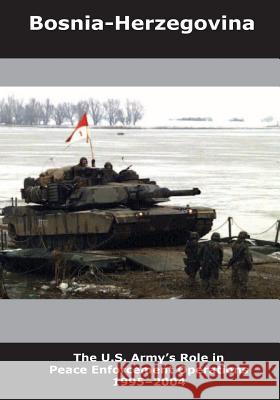
Bosnia-Herzegovina is an informative account of the U.S. Army's role and scope of its peace enforcement activities carried out from 1995 to 2004 in that war-torn country, the scene of the most violent armed conflict in Europe since World War II. The collapse of the Berlin Wall in 1989 marked the end of the Soviet Empire and its forcible control of Eastern Europe. Yugoslavia also showed cracks in its national structure, despite some forty years of enforced peace and harmony, and its sudden disintegration in 1991-92 resulted in almost a quarter-million deaths and more than a million refugees...
Bosnia-Herzegovina is an informative account of the U.S. Army's role and scope of its peace enforcement activities carried out from 1995 to 2004 in th...