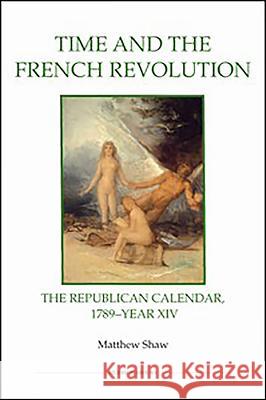
The French Republican Calendar was perhaps the boldest of all the reforms undertaken in Revolutionary France. Introduced in 1793 and used until 1806, the Calendar not only reformed the weeks and months of the year, but decimalised the hours of the day and dated the year from the beginning of the French Republic. This book not only provides a history of the calendar, but places it in the context of eighteenth-century time-consciousness, arguing that the French were adept at working within several systems of time-keeping, whether that of the Church, civil society, or the rhythms of the seasons....
The French Republican Calendar was perhaps the boldest of all the reforms undertaken in Revolutionary France. Introduced in 1793 and used until 1806, ...
This book charts new territory both theoretically and methodologically. Drawing on MacDougall's notion of social aesthetics, it explores the sensory dimensions of privilege through a global ethnography of elite schools. The various contributors to the volume draw on a range of theoretical perspectives from Lefebvre, Benjamin, Bourdieu, Appadurai, Kress and van Leeuwen to both broaden and critique MacDougall's original concept. They argue that within these elite schools there is a relationship between their 'complex sensory and aesthetic environments' and the construction of privilege within...
This book charts new territory both theoretically and methodologically. Drawing on MacDougall's notion of social aesthetics, it explores the sensory d...
They argue that within these elite schools there is a relationship between their `complex sensory and aesthetic environments' and the construction of privilege within and beyond the school gates.
They argue that within these elite schools there is a relationship between their `complex sensory and aesthetic environments' and the construction of ...