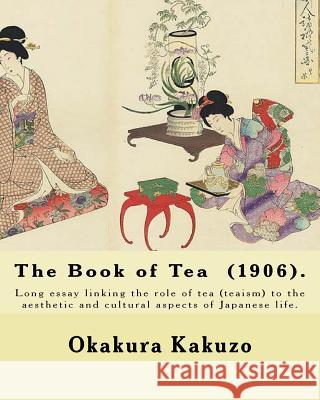
The Book of Tea discusses the impact of "Teaism" on all aspects of Japanese culture and life. Kakuzo elaborates on the relationship between tea ceremony and Zen and Taoism. He also talks about the tea masters and their contribution to the tea ceremony. Kakuzo spoke English from an early age, and so was able to make his writings accessible to the Western mind.
The Book of Tea discusses the impact of "Teaism" on all aspects of Japanese culture and life. Kakuzo elaborates on the relationship between tea ceremo...
Born in Yokohama to parents originally from Fukui, Okakura learned English while attending a school operated by Christian missionary, Dr. Curtis Hepburn. At 15, he entered Tokyo Imperial University, where he first met and studied under Harvard-educated professor Ernest Fenollosa. In 1889, Okakura co-founded the periodical Kokka February 14, 1862 - September 2, 1913) (also known as Okakura Tenshin) was a Japanese scholar who contributed to the development of arts in Japan. Outside Japan, he is chiefly remembered today as the author of The Book of Tea.
Born in Yokohama to parents originally from Fukui, Okakura learned English while attending a school operated by Christian missionary, Dr. Curtis Hepbu...
Born in Yokohama to parents originally from Fukui, Okakura learned English while attending a school operated by Christian missionary, Dr. Curtis Hepburn. At 15, he entered Tokyo Imperial University, where he first met and studied under Harvard-educated professor Ernest Fenollosa. In 1889, Okakura co-founded the periodical Kokka. In 1887 he was one of the
Born in Yokohama to parents originally from Fukui, Okakura learned English while attending a school operated by Christian missionary, Dr. Curtis Hepbu...
The original 1906 edition of The Book of Tea is one of the classic texts found on the desks of artists, poets, teaists and Zen Buddhists around the world. The book has been re-designed and expanded for a contemporary audience.
You will discover the fascinating character of Okakura Kakuzo and the story of how he came to write one of the twentieth century's most influential books on art, beauty, and simplicity--all steeped in the world's communal cup of tea. His incredible journey took him from Yokohama to New York, Paris, Bombay, and Boston, where his life intertwined with...
The original 1906 edition of The Book of Tea is one of the classic texts found on the desks of artists, poets, teaists and Zen Buddhists a...
The Book of Tea by Kakuzo Okakura - Tea began as a medicine and grew into a beverage. In China, in the eighth century, it entered the realm of poetry as one of the polite amusements. The fifteenth century saw Japan ennoble it into a religion of aestheticism-Teaism. Teaism is a cult founded on the adoration of the beautiful among the sordid facts of everyday existence. It inculcates purity and harmony, the mystery of mutual charity, the romanticism of the social order. It is essentially a worship of the Imperfect, as it is a tender attempt to accomplish something possible in this impossible...
The Book of Tea by Kakuzo Okakura - Tea began as a medicine and grew into a beverage. In China, in the eighth century, it entered the realm of poetry ...
kakuzo Okakura was a Japanese scholar who contributed to the development of arts in Japan. Outside Japan, he is chiefly remembered today as the author of The Book of Tea.
kakuzo Okakura was a Japanese scholar who contributed to the development of arts in Japan. Outside Japan, he is chiefly remembered today as the author...