Edited and with an Introduction by Matthew Pearl Includes "The Murders in the Rue Morgue," "The Mystery of Marie Roget," and "The Purloined Letter" Between 1841 and 1844, Edgar Allan Poe invented the genre of detective fiction with three mesmerizing stories of a young French eccentric named C. Auguste Dupin. Introducing to literature the concept of applying reason to solving crime, these tales brought Poe fame and fortune. Years later, Dorothy Sayers would describe "The Murders in the Rue Morgue" as "almost a complete manual of detective theory and...
Edited and with an Introduction by Matthew Pearl Includes "The Murders in the Rue Morgue," "The Mystery of Marie Roget," and "The Purloi...
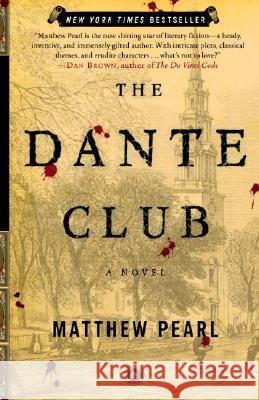
The New York Times Bestseller Boston, 1865. A series of murders, all of them inspired by scenes in Dante's Inferno. Only an elite group of America's first Dante scholars--Henry Wadsworth Longfellow, Oliver Wendell Holmes, James Russell Lowell, and J. T. Fields--can solve the mystery. With the police baffled, more lives endangered, and Dante's literary future at stake, the Dante Club must shed its sheltered literary existence and find the killer.
The New York Times Bestseller Boston, 1865. A series of murders, all of them inspired by scenes in Dante's Inferno. Only an elite gr...
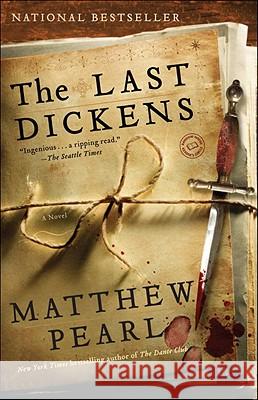
Boston, 1870. When news of Charles Dickens's sudden death reaches his struggling American publisher, James Osgood sends his trusted clerk, Daniel Sand, to await the arrival of Dickens's unfinished final manuscript. But Daniel never returns, and when his body is discovered by the docks, Osgood must embark on a quest to find the missing end to the novel and unmask the killer. With Daniel's sister Rebecca at his side, Osgood races the clock through a dangerous web of opium dens, sadistic thugs, and literary lions to solve a genius's last mystery and save his own-and Rebecca's-lives.
Boston, 1870. When news of Charles Dickens's sudden death reaches his struggling American publisher, James Osgood sends his trusted clerk, Daniel Sand...
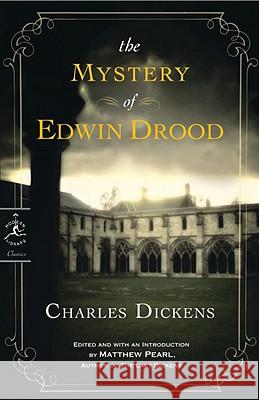
The Mystery of Edwin Drood is a novel that is itself the subject of one of literature's most enduring mysteries. The story recounts the troubled romance of Rosa Bud and the book's eponymous character, who later vanishes. Was Drood murdered, and if so by whom? All clues point to John Jasper, Drood's lugubrious uncle, who coveted Rosa. Or did Drood orchestrate his own disappearance? As Charles Dickens died before finishing the book, the ending is intriguingly ambiguous. In his Introduction, Matthew Pearl illuminates the 150-year-long quest to unravelThe Mystery of Edwin Drood...
The Mystery of Edwin Drood is a novel that is itself the subject of one of literature's most enduring mysteries. The story recounts the troubled roman...
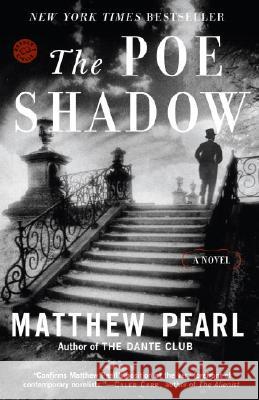
"I present to you . . . the truth about this man's death and my life." Baltimore, 1849. The body of Edgar Allan Poe has been buried in an unmarked grave. The public, the press, and even Poe's own family and friends accept the conclusion that Poe was a second-rate writer who met a disgraceful end as a drunkard. Everyone, in fact, seems to believe this except a young Baltimore lawyer named Quentin Clark, an ardent admirer who puts his own career and reputation at risk in a passionate crusade to salvage Poe's. As Quentin explores the puzzling circumstances of Poe's demise, he discovers...
"I present to you . . . the truth about this man's death and my life." Baltimore, 1849. The body of Edgar Allan Poe has been buried in an unmarked...