Private Lives in the Public Sphere examines the Bildungsroman in the context of the rapid changes that affected the German literary revolution that made up for its belatedness in its rapidity and scope. The nature and quantity of reading material produced, the social status of the writer, and the reading habits of the public changed dramatically within a few decades. At the beginning of the century the new texts that appeared at the annual book fairs were primarily written in Latin and devoted to theology. By the end of the century the number of new publications each year...
Private Lives in the Public Sphere examines the Bildungsroman in the context of the rapid changes that affected the German litera...
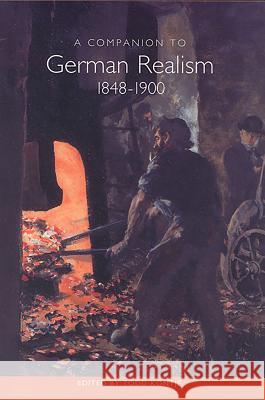
This volume of new essays by leading scholars treats a representative sampling of German realist prose from the period 1848 to 1900, the period of its dominance of the German literary landscape. It includes essays on familiar, canonical authors -- Stifter, Freytag, Raabe, Fontane, Thomas Mann -- and canonical texts, but also considers writers frequently omitted from traditional literary histories, such as Luise Muhlbach, Friedrich Spielhagen, Louise von Francois, Karl May, and Eugenie Marlitt. The introduction situates German realism in the context of both German literary history and of...
This volume of new essays by leading scholars treats a representative sampling of German realist prose from the period 1848 to 1900, the period of its...
Nobel Prize-winner Thomas Mann (1875 1955) is not only one of the leading German novelists of the twentieth century, but also one of the few to transcend national and language boundaries to achieve major stature in the English-speaking world. Famous from the time that he published his first novel in 1901, Mann became an iconic figure, seen as the living embodiment of German national culture. Leading scholar Todd Kontje provides a succinct introduction to Mann's life and work, discussing key moments in Mann's personal life and his career as a public intellectual, and giving readers a sense of...
Nobel Prize-winner Thomas Mann (1875 1955) is not only one of the leading German novelists of the twentieth century, but also one of the few to transc...
Nobel Prize-winner Thomas Mann (1875 1955) is not only one of the leading German novelists of the twentieth century, but also one of the few to transcend national and language boundaries to achieve major stature in the English-speaking world. Famous from the time that he published his first novel in 1901, Mann became an iconic figure, seen as the living embodiment of German national culture. Leading scholar Todd Kontje provides a succinct introduction to Mann's life and work, discussing key moments in Mann's personal life and his career as a public intellectual, and giving readers a sense of...
Nobel Prize-winner Thomas Mann (1875 1955) is not only one of the leading German novelists of the twentieth century, but also one of the few to transc...
Explores ways in which writers from late antiquity to the present have imagined communities before and beyond the nation-state. It takes as its point of departure challenges to the discrete nation-state posed by globalization, migration, and European integration today, but then circles back to the beginnings of European history after the fall of the Roman Empire.
Explores ways in which writers from late antiquity to the present have imagined communities before and beyond the nation-state. It takes as its point ...