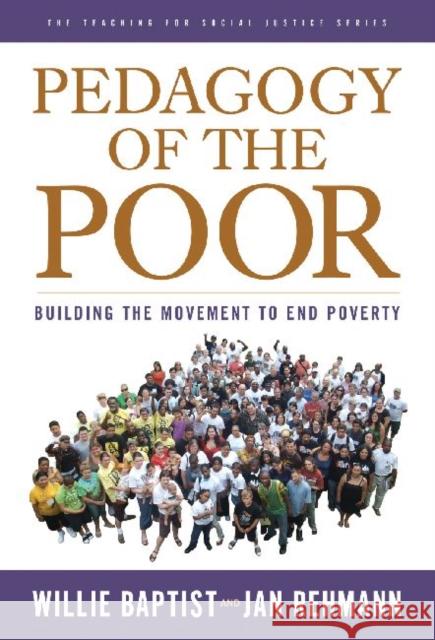
The authors present a new kind of interdisciplinary pedagogy that brings together antipoverty grassroots activism and relevant social theories about poverty. This unique book combines the oral history of a renowned antipoverty organizer with accessible introductions to relevant social theories, case studies, in-class student debates, and pedagogical reflections. This multilayered approach makes it useful to both social activists committed to eradicating poverty and educators looking for ways to teach about the struggles for economic and social justice.
The authors present a new kind of interdisciplinary pedagogy that brings together antipoverty grassroots activism and relevant social theories about p...
The emergence of ideology theories marked a re-foundation of Marxist research into the functioning of alienation and subjection. Going beyond traditional concepts of 'manipulation' and 'false consciousness', they turned to the material existence of hegemonic apparatuses and focused on the mostly unconscious effects of ideological practices, rituals and discourses. In this magisterial work Jan Rehmann reconstructs the different strands of ideology theories ranging from Marx to Adorno/Horkheimer, from Lenin to Gramsci, from Althusser to Stuart Hall, from Bourdieu to W.F. Haug, from Foucault...
The emergence of ideology theories marked a re-foundation of Marxist research into the functioning of alienation and subjection. Going beyond traditio...
With Gramsci's theory of hegemony as his starting point, this volume provides a comprehensive socio-analysis of Max Weber's political and intellectual position in the ideological network of his time. Rehmann lucidly and witheringly argues that, even though Weber presents his science as'value-free, ' the forefather of sociology's system is best understood as an organic intellectual of the bourgeoisie advocating for a new model of capitalist hegemony.
With Gramsci's theory of hegemony as his starting point, this volume provides a comprehensive socio-analysis of Max Weber's political and intellectual...
How to explain the hegemonic stability of neoliberal capitalism even in the midst of its crises? The emergence of ideology theories marked a re-foundation of Marxist research into the functioning of alienation and subjection. Going beyond traditional concepts of 'manipulation' and 'false consciousness', they turned to the material existence of hegemonic apparatuses and focused on the mostly unconscious effects of ideological practices, rituals and discourses. Jan Rehmann reconstructs the different strands of ideology theories ranging from Marx to Adorno/Horkheimer, from Lenin to Gramsci, from...
How to explain the hegemonic stability of neoliberal capitalism even in the midst of its crises? The emergence of ideology theories marked a re-founda...