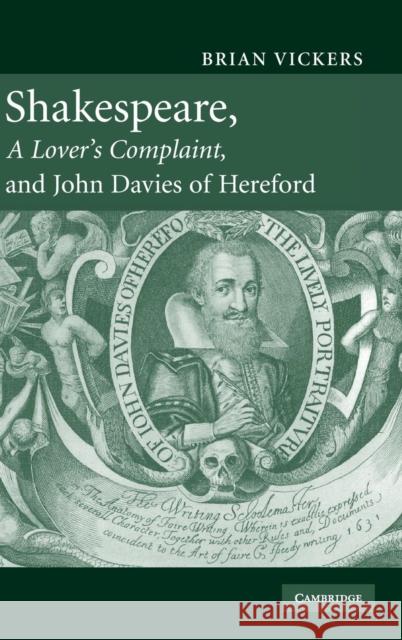
When Shakespeare's Sonnets were published in 1609 a poem called A Lover's Complaint was included by the publisher, Thomas Thorpe, who was notorious for several irregular publications. Many scholars have doubted its authenticity, but recent editions of the Sonnets have accepted it as Shakespeare's work. Now Vickers, in this text, the first full study of the poem, shows it to be un-Shakespearian both in its language and in its attitude to women. It is awkwardly constructed and uses archaic Spenserian diction, including many unusual words that never occur in Shakespeare. It frequently repeats...
When Shakespeare's Sonnets were published in 1609 a poem called A Lover's Complaint was included by the publisher, Thomas Thorpe, who was notorious fo...
Back in print after 17 years, this is a concise history of rhetoric as it relates to structure, genre, and style, with special reference to English literature and literary criticism from Ancient Greece to the end of the 18th century.
The core of the book is a quite original argument that the figures of rhetoric were not mere mechanical devices, were not, as many believed, a "nuisance, a quite sterile appendage to rhetoric to which (unaccountably) teachers, pupils, and writers all over the world devoted much labor for over 2,000 years." Rather, Vickers demonstrates, rhetoric was a...
Back in print after 17 years, this is a concise history of rhetoric as it relates to structure, genre, and style, with special reference to English...
The question of whether Paul teaches that Christ's righteousness is imputed to the believer has been debated for roughly four hundred years. Some of the questions that arise are: What is the connection between Adam and the rest of the human race? How did Christ fulfill the role of the second or new Adam? How can the "ungodly" stand before a righteous God?
In Jesus' Blood and Righteousness, Brian Vickers investigates the key Pauline texts linked historically to the topic of imputation. Though Vickers spends a good deal of time on the particulars of each text, he keeps one...
The question of whether Paul teaches that Christ's righteousness is imputed to the believer has been debated for roughly four hundred years. Some o...
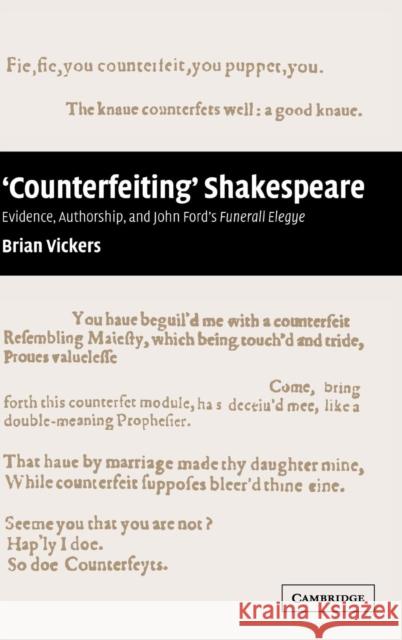
Brian Vickers addresses the fundamental issues of what Shakespeare actually wrote, and how this is determined. In recent years Shakespeare's authorship has been claimed for two poems, the lyric "Shall I die?" and A Funerall Elegye. These attributions have been accepted into certain major editions of Shakespeare's works. Through a new examination of the evidence, Professor Vickers shows that neither poem has the stylistic and imaginative qualities we associate with Shakespeare. He identifies the poet and dramatist John Ford as the actual author of the Elegye.
Brian Vickers addresses the fundamental issues of what Shakespeare actually wrote, and how this is determined. In recent years Shakespeare's authorshi...
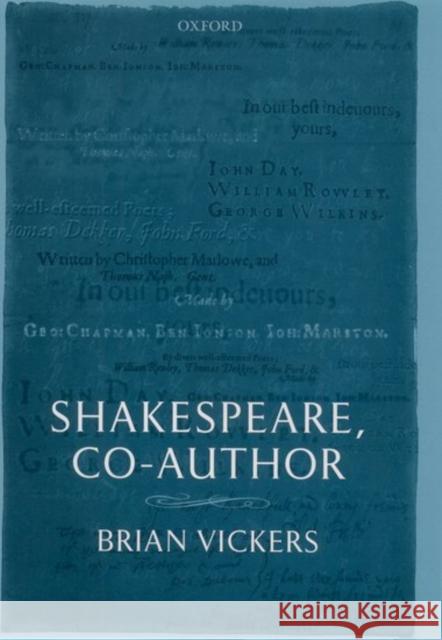
This major new study asks the question, "how much do we know about Shakespeare's collaborations with other dramatists?," and sets out to provide a detailed evaluation of the claims made for Shakespeare's co-authorship of Titus Andronicus, Timon of Athens, Pericles, Henry VIII, and The Two Noble Kinsmen. Through an examination of the processes of collaboration and the methods used in authorship studies since the early nineteenth century, Brian Vickers identifies a coherent tradition in attribution work on Shakespeare.
This major new study asks the question, "how much do we know about Shakespeare's collaborations with other dramatists?," and sets out to provide a det...
The full study of Bacon as a writer, Dr Vickers takes into account the whole corpus of Bacon's work, in Latin as well as in English. His chief sources are the The Advancement of Learning and the Essays. His purpose is to reinstate Bacon as one of the supreme masters of English prose in a period which made rich use of all the expressive resources of the medium. The study is both analytical and historical: it isolates the major features of Bacon's style, and sets them in the context of Renaissance theory and practice. The features include the overall structure of Bacon's works, his important...
The full study of Bacon as a writer, Dr Vickers takes into account the whole corpus of Bacon's work, in Latin as well as in English. His chief sources...