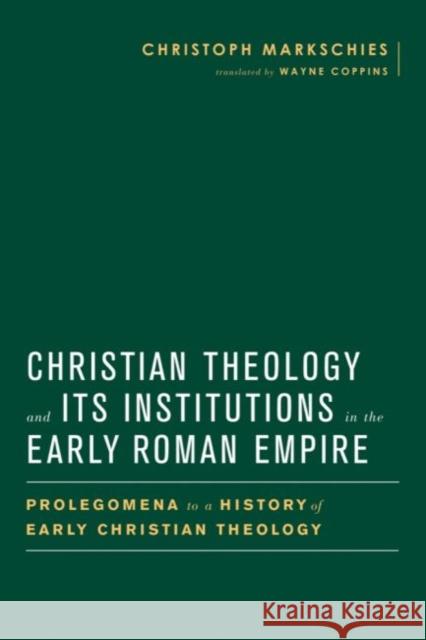
Tension between unity and diversity plagues any attempt to recount the development of earliest Christianity. Explanations run the gamut from asserting the presence of a fully formed and accepted unity at the beginning of Christianity to the hypothesis that understands orthodox unity as a later imposition upon Christianity by Rome. In "Christian Theology and Its Institutions in the Early Roman Empire," Christoph Markschies seeks to unravel the complex problem of unity and diversity by carefully examining the institutional settings for the development of Christian theology. Specifically,...
Tension between unity and diversity plagues any attempt to recount the development of earliest Christianity. Explanations run the gamut from assert...
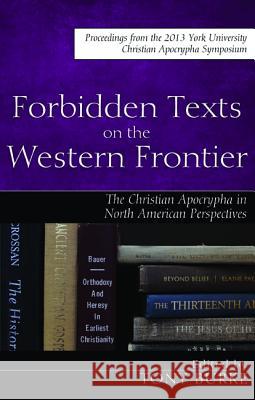
North American study of the Christian Apocrypha is known principally for its interest in using noncanonical texts to reconstruct the life and teachings of Jesus, and for its support of Walter Bauer's theory on the development of early Christianity. The papers in this volume, presented in September 2013 at York University in Toronto, challenge that simplistic assessment by demonstrating that U.S. and Canadian scholarship on the Christian Apocrypha is rich and diverse. The topics covered in the papers include new developments in the study of canon formation, the interplay of Christian Apocrypha...
North American study of the Christian Apocrypha is known principally for its interest in using noncanonical texts to reconstruct the life and teaching...
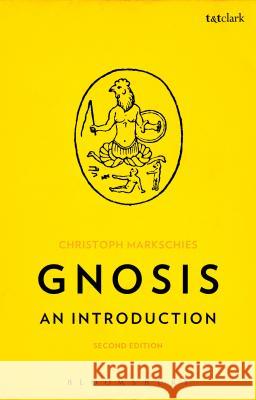
This introduction to gnosis by Christoph Markschies combines clarity with a huge wealth of learning. Markschies defines the term gnosis and its relationship to 'Gnosticism', indicating why gnosis is preferable and sketches out the main problems. He then introduces sources, both those in the Church Fathers and the more recent Nag Hammadi finds. Next, Markschies provides an overview of the early forms of 'gnosis' in antiquity, Jewish and Christian (New Testament) and the early gnostics. This is followed with an outline of the main representatives and key figures of Gnosis, especially...
This introduction to gnosis by Christoph Markschies combines clarity with a huge wealth of learning. Markschies defines the term gnosis and its rel...
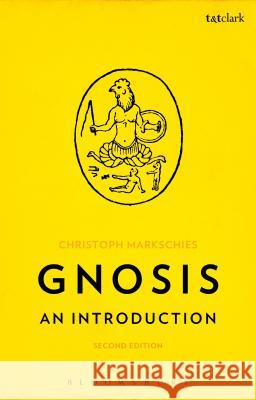
This introduction to gnosis by Christoph Markschies combines clarity with a huge wealth of learning. Markschies defines the term gnosis and its relationship to 'Gnosticism', indicating why gnosis is preferable and sketches out the main problems. He then introduces sources, both those in the Church Fathers and the more recent Nag Hammadi finds. Next, Markschies provides an overview of the early forms of 'gnosis' in antiquity, Jewish and Christian (New Testament) and the early gnostics. This is followed with an outline of the main representatives and key figures of Gnosis, especially...
This introduction to gnosis by Christoph Markschies combines clarity with a huge wealth of learning. Markschies defines the term gnosis and its rel...