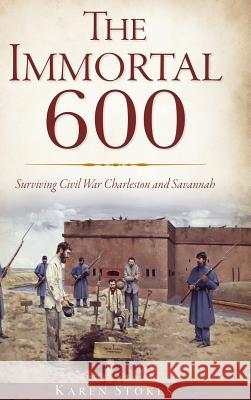
In 1864, six hundred Confederate prisoners of war, all officers, were taken out of a prison camp in Delaware and transported to South Carolina, where most were confined in a Union stockade prison on Morris Island. They were placed in front of two Union forts as "human shields" during the siege of Charleston and exposed to a fearful barrage of artillery fire from Confederate forts. Many of these men would suffer an even worse ordeal at Union-held Fort Pulaski near Savannah, Georgia, where they were subjected to severe food rationing as retaliatory policy. Author and historian Karen Stokes uses...
In 1864, six hundred Confederate prisoners of war, all officers, were taken out of a prison camp in Delaware and transported to South Carolina, where ...
The Civil War never left South Carolina, from its beginning at Fort Sumter in 1861 through the destructive, harrowing days of Sherman s march through the state in 1865. Included here are the stories of Confederate civilians and soldiers who remained true to their cause throughout the perilous struggle. An English aristocrat risked his life to run the blockade and become one of the defenders of Charleston. The Haskells of Abbeville sent seven sons into Confederate service. Many South Carolina women made heart-rending sacrifices, including a disabled woman from Laurens County whose heroic...
The Civil War never left South Carolina, from its beginning at Fort Sumter in 1861 through the destructive, harrowing days of Sherman s march through ...
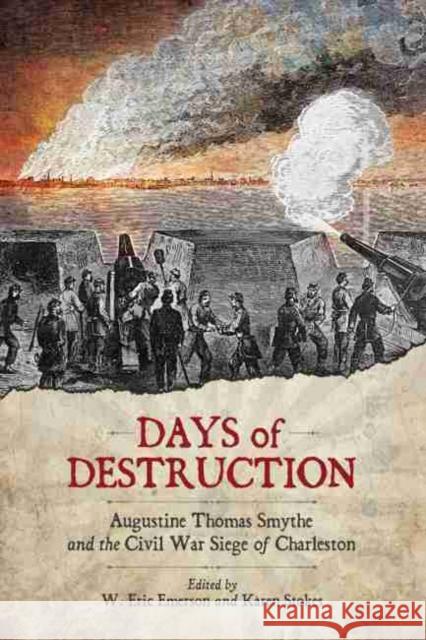
In Days of Destruction, editors W. Eric Emerson and Karen Stokes chronicle the events of the siege of Charleston, South Carolina, through a collection of letters written by Augustine Thomas Smythe, a well-educated young man from a prominent Charleston family. The vivid, eloquent letters he wrote to his family depict all that he saw and experienced during the long, destructive assault on the Holy City and describe in detail the damage done to Charleston's houses, churches, and other buildings in the desolated shell district, as well as the toll on human life. Smythe's role in the Civil...
In Days of Destruction, editors W. Eric Emerson and Karen Stokes chronicle the events of the siege of Charleston, South Carolina, through a collection...
THE WAR CRIMES committed by General William T. Sherman and his men against Southern civilians and their means of sustaining life are a huge stain on the American national character. Sherman's crimes are routinely denied or minimized (by those who don't actually celebrate them), although they are as heavily documented, from Northern as well as Southern sources, as any event in history. Sherman's campaign through Georgia and South Carolina is even cited as a brilliant military feat. In fact, it was not a military feat at all. There was very little fighting. It was a massive campaign of...
THE WAR CRIMES committed by General William T. Sherman and his men against Southern civilians and their means of sustaining life are a huge stain on t...