The battle at Kursk in 1943 is often referred to as the greatest tank battle in the history of warfare. This volume makes extensive use of German archival documents as well as various Russian books and articles. It attempts to answer such questions as what forces were actually engaged; how were they equipped; what were their capabilities; and what was the cost of the battle. The book also addresses methodological issues, applicable not only to this battle, but to other battles in World War II.
The battle at Kursk in 1943 is often referred to as the greatest tank battle in the history of warfare. This volume makes extensive use of German arch...
The battle at Kursk in 1943 is often referred to as the greatest tank battle in the history of warfare. This volume makes extensive use of German archival documents as well as various Russian books and articles. As well as an account of the battle, it addresses methodological issues.
The battle at Kursk in 1943 is often referred to as the greatest tank battle in the history of warfare. This volume makes extensive use of German arch...
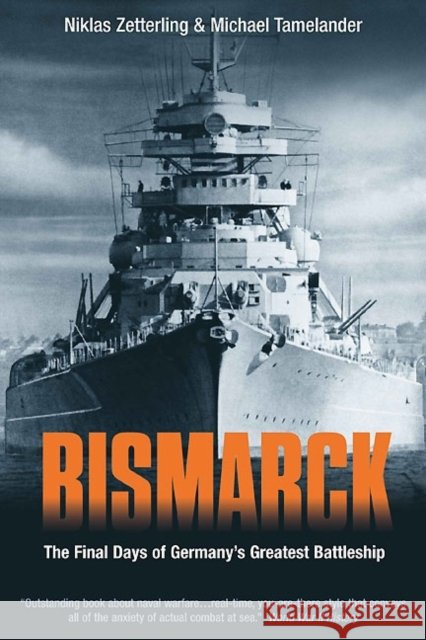
A gripping tale of heroism --and doom--on the high seas . . . The sinking of the German battleship Bismarck--a masterpiece of engineering, well-armored with a main artillery of eight 15-inch guns--was one of the most dramatic events of World War II. She left the port of Gotenhafen for her first operation on the night of 18 May 1941, yet was almost immediately discovered by Norwegian resistance and Allied air reconnaissance. British battlecruiser Hood was quickly dispatched from Scapa Flow to intercept the Bismarck, together with new battleship Prince of Wales. They were ordered to find the...
A gripping tale of heroism --and doom--on the high seas . . . The sinking of the German battleship Bismarck--a masterpiece of engineering, well-armore...
During the second half of 1943, after the failure at Kursk, Germany's Army Group South fell back from Russia under repeated hammer blows from the Red Army. Under Erich von Manstein, however, the Germans were able to avoid serious defeats, while at the same time fending off Hitler's insane orders to hold on to useless territory. Then, in January 1944, a disaster happened. Six divisions of Army Group South became surrounded after sudden attacks by the 1st and 2nd Ukrainian Fronts under command of generals Nikolai Vatutin and Ivan Konev around the village of Korsun (near the larger town of...
During the second half of 1943, after the failure at Kursk, Germany's Army Group South fell back from Russia under repeated hammer blows from the Red ...
A gripping tale of heroism --and doom--on the high seas . . . The sinking of the German battleship Bismarck--a masterpiece of engineering, well-armored with a main artillery of eight 15-inch guns--was one of the most dramatic events of World War II. She left the port of Gotenhafen for her first operation on the night of 18 May 1941, yet was almost immediately discovered by Norwegian resistance and Allied air reconnaissance. British battlecruiser Hood was quickly dispatched from Scapa Flow to intercept the Bismarck, together with new battleship Prince of Wales. They were ordered to find the...
A gripping tale of heroism --and doom--on the high seas . . . The sinking of the German battleship Bismarck--a masterpiece of engineering, well-armore...
At the end of September 1941, more than a million German soldiers lined up along the frontline just 180 miles west of Moscow. They were well trained, confident, and had good reasons to hope that the war in the East would be over with one last offensive. Facing them was an equally large Soviet force, but whose soldiers were neither as well trained nor as confident. When the Germans struck, disaster soon befell the Soviet defenders. German panzer spearheads cut through enemy defenses and thrust deeply to encircle most of the Soviet soldiers on the approaches to Moscow. Within a few weeks, most...
At the end of September 1941, more than a million German soldiers lined up along the frontline just 180 miles west of Moscow. They were well trained, ...
At the end of September 1941, more than a million German soldiers lined up along the frontline just 180 miles west of Moscow. They were well trained, confident, and had good reasons to hope that the war in the East would be over with one last offensive.
At the end of September 1941, more than a million German soldiers lined up along the frontline just 180 miles west of Moscow. They were well trained, ...