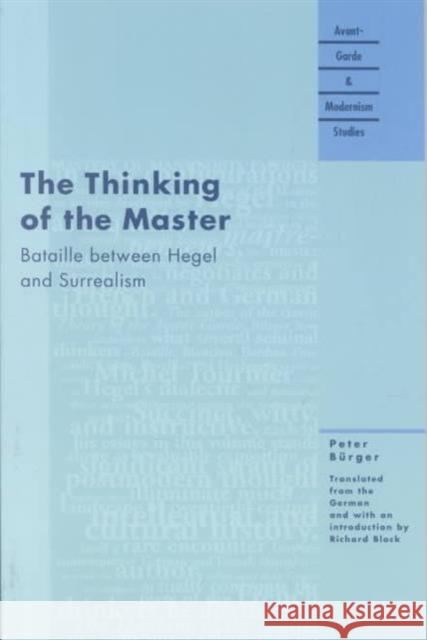
Mastery of many sorts emerges in new configurations in Peter Burger's "The Thinking of the Master" as an idea developed by Hegel in the master/slave dialectic in his "Phenomenology of Spirit" as a quality embodied in the work of certain twentieth-century "maitre-penseurs, " or "master thinkers"; and, not least, in the expertise of Burger himself as he negotiates and clarified a critical intersection of contemporary French and German thought. The author of the classic "Theory of the Avant-Garde, " Burger here considers what several seminal thinkers--among them Bataille, Barthes, Foucault, and...
Mastery of many sorts emerges in new configurations in Peter Burger's "The Thinking of the Master" as an idea developed by Hegel in the master/slave d...
Mastery of many sorts emerges in new configurations in Peter Burger's book: as an idea developed by Hegel in the master-slave dialectic in his Phenomenology of Spirit; as a quality embodied in the work of certain 20th century master-thinkers; and, not least, in the expertise of Burger himself, as he negotiates and clarifies a critical intersection of contemporary French and German thought. Burger here considers what several seminal thinkers - Bataille, Blanchot, Barthes, Foucault, Lacan, Derrida, Heidegger, as well as novelist Michel Tournier - owe to Hegel's dialectic, and measures their...
Mastery of many sorts emerges in new configurations in Peter Burger's book: as an idea developed by Hegel in the master-slave dialectic in his Phenome...