If nothing else, the war in Iraq and the 1991 Gulf War have taught us much about media and technology as key players in how war is waged, packaged for public consumption, and exported in real time to the rest of the globe. A critic of the art of technology, Paul Virilio has keenly observed that media images quite often constitute a strategy of war and that accident is becoming indistinguishable from attack. For more than fifty years Virilio has offered incisive and provocative criticism on technology and its moral, political, and cultural implications. Yet until now, much of his work,...
If nothing else, the war in Iraq and the 1991 Gulf War have taught us much about media and technology as key players in how war is waged, packaged for...
The future once promised the certainty of a better life for all but now it is full of uncertainty, danger and fear. Our lives are surrounded by the threats, imaginary or real, posed by terrorist outrages, natural catastrophes and disasters of all kinds. The future is overshadowed by the nightmare of an outmoded humanity overwhelmed by a catastrophe of its own making, a kind of catastrophic grand finale that would mirror the original accident - the Big Bang - that some scientists believe created the universe.
A biting meditation on Progress technoscientific progress, at...
The future once promised the certainty of a better life for all but now it is full of uncertainty, danger and fear. Our lives are surrounded by the th...
Paul Virilio demonstrates how technology has made inertia the defining condition of modernity. An instantaneous present has replaced space and the sovereignty of territory - everything happens without the need to go anywhere.
Paul Virilio demonstrates how technology has made inertia the defining condition of modernity. An instantaneous present has replaced space and the sov...
Paul Virilio demonstrates how technology has made inertia the defining condition of modernity. An instantaneous present has replaced space and the sovereignty of territory - everything happens without the need to go anywhere.
Paul Virilio demonstrates how technology has made inertia the defining condition of modernity. An instantaneous present has replaced space and the sov...
Edited by one of the leading Virilio authority's, this book offers the reader a guide through Virilio's work. Using the interview form, Virilio speaks incisively and at length about a vast assortment of cultural and theoretical topics, including architecture and speed-space', chronopolitics', art and technoculture, modernism, postmodernism and hypermodernism', the time of the trajectory and the information bomb'. His thoughts on Foucault, Baudrillard, Deleuze and Guattari, the performance artist Stelarc, the Persian War and the Kosovo War, are also gathered together.
Edited by one of the leading Virilio authority's, this book offers the reader a guide through Virilio's work. Using the interview form, Virilio speaks...
Using the interview form, the author tells about a vast assortment of cultural and theoretical topics, including architecture and 'speed-space', 'chronopolitics', art and technoculture, modernism, postmodernism and 'hypermodernism', the time of the trajectory and the 'information bomb'.
Using the interview form, the author tells about a vast assortment of cultural and theoretical topics, including architecture and 'speed-space', 'chro...
The Art of the Motor includes analyses of such recent developments as nanotechnology and virtual reality. It conjures a world in which information is speed and duration is no more. Information as speed? This, Paul Virilio tells us, is the third dimension of matter-the speed of the transmission of information has collapsed the extension of the dimension of space and the duration of the dimension of time.
The Art of the Motor includes analyses of such recent developments as nanotechnology and virtual reality. It conjures a world in which information is ...
First English language collection of the writing of French social critic, Paul Virilio. This volume represents his most important work, including five new translations and an exclusive interview with Virlio conducted by the editor reflecting the diverse career of this great social commentator on life in the late twentieth century.
First English language collection of the writing of French social critic, Paul Virilio. This volume represents his most important work, including five...
The accident is a new form of warfare. It is replacing revolution and war. Sarajevo triggered the First World War. New York is what Sarajevo was. September 11th opened Pandora's box. The first war of globalization will be the global accident, the total accident, including the accident of science. And it is on the way.In 1968, Virilio abandoned his work in oblique architecture, believing that time had replaced space as the most important point of reflection because of the dominance of speed.We were basically on the verge of converting space time into space speed... Speed facilitates the...
The accident is a new form of warfare. It is replacing revolution and war. Sarajevo triggered the First World War. New York is what Sarajevo was. S...
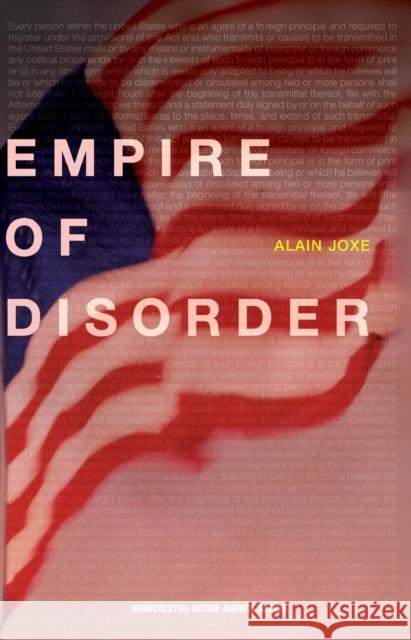
In The Empire of Disorder, Alain Joxe offers the first truly comprehensive analysis of the new world disorder of the twenty-first century. The contemporary world, claims Joxe, is dominated by the American empire but not ordered by it. This -leadership through chaos, - based on maintaining a -creeping peace, - is at the root of the present organization of violence and barbary on a global scale. At the same time, national governments--including that of the United States--are declining in influence as the imperial system fosters transnational mafias, corporations, and markets.
In The Empire of Disorder, Alain Joxe offers the first truly comprehensive analysis of the new world disorder of the twenty-first century. The cont...