Ezra Pound's book on the French sculptor Henri Gaudier-Brzeska was first published in 1916. An enlarged edition, including thirty pages of illustrations (sculpture and drawings) as well as Pound's later pieces on Gaudier, was brought out in 1970, and is now re-issued as an ND Paperbook. The memoir is valuable both for the history of modern art and for what it shows us of Pound himself, his ability to recognize genius in others and then to publicize it effectively. Would there today be a Salle Gaudier-Brzeska in the Musee de L'Art Moderne in Paris if Pound had not championed him? Gaudier's...
Ezra Pound's book on the French sculptor Henri Gaudier-Brzeska was first published in 1916. An enlarged edition, including thirty pages of illustratio...
Since the 1969 revised edition, the Italian Cantos LXXII and LXXIII (as well as a 1966 fragment concluding the work) have been added. Now appearing for the first time is Pound's recently found Eglish translation of Italian Canto LXXII.
Since the 1969 revised edition, the Italian Cantos LXXII and LXXIII (as well as a 1966 fragment concluding the work) have been added. Now appearing fo...
Eliot Weinberger William Carlos Williams Ezra Pound
A rich compendium of translations, The New Directions Anthology of Classical Chinese Poetry is the first collection to look at Chinese poetry through its enormous influence on American poetry. Weinberger begins with Ezra Pound's Cathay (1915), and includes translations by three other major U.S. poets -- William Carlos Williams, Kenneth Rexroth, Gary Snyder -- and an important poet-translator-scholar, David Hinton, all of whom have long been associated with New Directions. Moreover, it is the first general anthology ever to consider the process of translation by presenting different versions...
A rich compendium of translations, The New Directions Anthology of Classical Chinese Poetry is the first collection to look at Chinese poetry through ...
"Machine Art and Other Writings" presents previously unpublished and rare writings by one of the literary giants of the modernist period, Ezra Pound. Written from the late 1920s to the early part of the 1940s, these essays, selected by Maria Luisa Ardizzone and including "Machine Art," "How To Write," "European Paideuma," and "Pragmatic Aesthetics," are typically Poundian in style--irascible, eccentric, and by turns both engaging and cryptic. Importantly, these essays from Pound's Italian years shed light both on the sections of the "Cantos" written in the late 1940s and on the underpinnings...
"Machine Art and Other Writings" presents previously unpublished and rare writings by one of the literary giants of the modernist period, Ezra Pound. ...
Poetic visionary Ezra Pound catalyzed American literature's modernist revolution. This volume, the most comprehensive collection of his poetry and translations ever assembled, gathers all his verse except "The Cantos."
Poetic visionary Ezra Pound catalyzed American literature's modernist revolution. This volume, the most comprehensive collection of his poetry and tra...
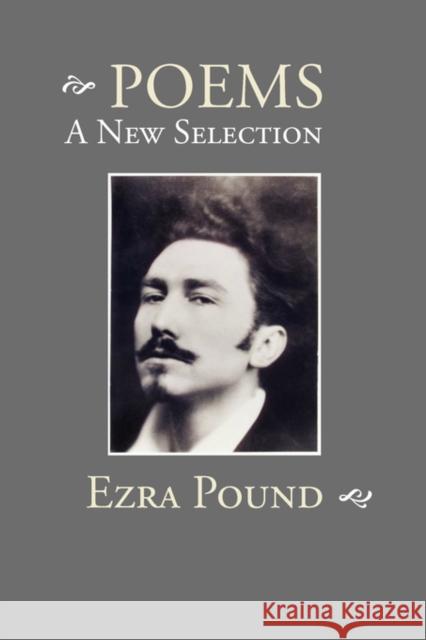
Ezra Pound has been called a "poetic visionary" and the "catalyst of the American modernist movement." All of his work collected runs well over 1,000 pages. Here is a new collection of the best of the best of the poetic work of the young Pound, filled with creative energy, verbal virtuosity, and clear-sighted vision. His continuing goal was to "make it new," and so he did. This volume includes some of Pound's most powerful and most memorable poems from Personae, Exultations, Ripostes, Cathay, Lustra, and Hugh Selwyn Mauberley, along with several other Pound collections. It also includes some...
Ezra Pound has been called a "poetic visionary" and the "catalyst of the American modernist movement." All of his work collected runs well over 1,000 ...