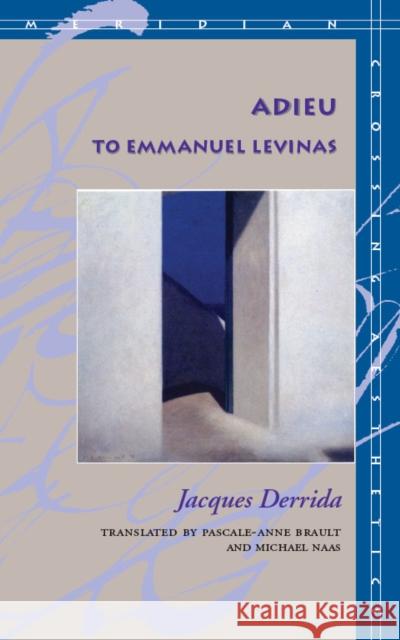
This volume contains the speech given by Derrida at Emmanuel Levinas's funeral on December 27, 1995, and his contribution to a colloquium organized to mark the first anniversary of Levinas's death. For both thinkers, the word adieu names a fundamental characteristic of human being: the salutation or benediction prior to all constative language (in certain circumstances, one can say adieu at the moment of meeting) and that given at the moment of separation, sometimes forever, as at the moment of death, it is also the a-dieu, for God or to God before and in any relation to...
This volume contains the speech given by Derrida at Emmanuel Levinas's funeral on December 27, 1995, and his contribution to a colloquium organized to...
Taking on the Tradition focuses on how the work of Jacques Derrida has helped us rethink and rework the themes of tradition, legacy, and inheritance in the Western philosophical tradition. It concentrates not only on such themes in the work of Derrida but also on his own gestures with regard to these themes--that is, on the performativity of Derrida's texts. The book thus uses Derrida's understanding of speech act theory to reread his own work. The book consists in a series of close readings of Derrida's texts to demonstrate that the claims he makes in his work cannot be fully...
Taking on the Tradition focuses on how the work of Jacques Derrida has helped us rethink and rework the themes of tradition, legacy, and inheri...
Taking on the Tradition focuses on how the work of Jacques Derrida has helped us rethink and rework the themes of tradition, legacy, and inheritance in the Western philosophical tradition. It concentrates not only on such themes in the work of Derrida but also on his own gestures with regard to these themes--that is, on the performativity of Derrida's texts. The book thus uses Derrida's understanding of speech act theory to reread his own work. The book consists in a series of close readings of Derrida's texts to demonstrate that the claims he makes in his work cannot be fully...
Taking on the Tradition focuses on how the work of Jacques Derrida has helped us rethink and rework the themes of tradition, legacy, and inheri...
Written in the wake of Jacques Derrida's death in 2004, Derrida From Now On attempts both to do justice to the memory of Derrida and to demonstrate the continuing significance of his work for contemporary philosophy and literary theory. If Derrida's thought is to remain relevant for us today, it must be at once understood in its original context and uprooted and transplanted elsewhere. Michael Naas thus begins with an analysis of Derrida's attachment to the French language, to Europe, and to European secular thought, before turning to Derrida's long engagement with the American context and to...
Written in the wake of Jacques Derrida's death in 2004, Derrida From Now On attempts both to do justice to the memory of Derrida and to demonstrate th...
Written in the wake of Jacques Derrida's death in 2004, Derrida From Now On attempts both to do justice to the memory of Derrida and to demonstrate the continuing significance of his work for contemporary philosophy and literary theory. If Derrida's thought is to remain relevant for us today, it must be at once understood in its original context and uprooted and transplanted elsewhere. Michael Naas thus begins with an analysis of Derrida's attachment to the French language, to Europe, and to European secular thought, before turning to Derrida's long engagement with the American context and to...
Written in the wake of Jacques Derrida's death in 2004, Derrida From Now On attempts both to do justice to the memory of Derrida and to demonstrate th...
This volume contains the speech given by Derrida at Emmanuel Levinas's funeral on December 27, 1995, and his contribution to a colloquium organized to mark the first anniversary of Levinas's death. For both thinkers, the word adieu names a fundamental characteristic of human being: the salutation or benediction prior to all constative language (in certain circumstances, one can say adieu at the moment of meeting) and that given at the moment of separation, sometimes forever, as at the moment of death, it is also the a-dieu, for God or to God before and in any relation to...
This volume contains the speech given by Derrida at Emmanuel Levinas's funeral on December 27, 1995, and his contribution to a colloquium organized to...
Miracle and Machine is a sort of "reader's guide" to Jacques Derrida's 1994-95 essay "faith and knowledge," his most important work on the nature of religion in general and on the unprecedented forms it is taking today through science and the media. It provides essential background for understanding Derrida's essay, commentary on its unique style and its central figures (e.g., Kant, Hegel, Bergson, and Heidegger), and assessment of its principal philosophical claims about the fundamental duplicity of religion and the ineluctably autoimmune relationship among religion, science, and the media....
Miracle and Machine is a sort of "reader's guide" to Jacques Derrida's 1994-95 essay "faith and knowledge," his most important work on the nature of r...
Miracle and Machine is a sort of "reader's guide" to Jacques Derrida's 1994 essay "faith and knowledge," his most important work on the nature of religion in general and on the unprecedented forms it is taking today through science and the media. It provides essential background for understanding Derrida's essay, commentary on its unique style and its central figures (e.g., Kant, Hegel, Bergson, and Heidegger), and assessment of its principal philosophical claims about the fundamental duplicity of religion and the ineluctably autoimmune relationship among religion, science, and the...
Miracle and Machine is a sort of "reader's guide" to Jacques Derrida's 1994 essay "faith and knowledge," his most important work on the natur...
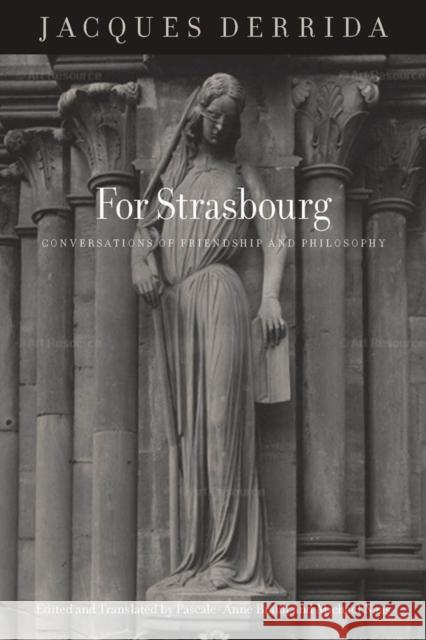
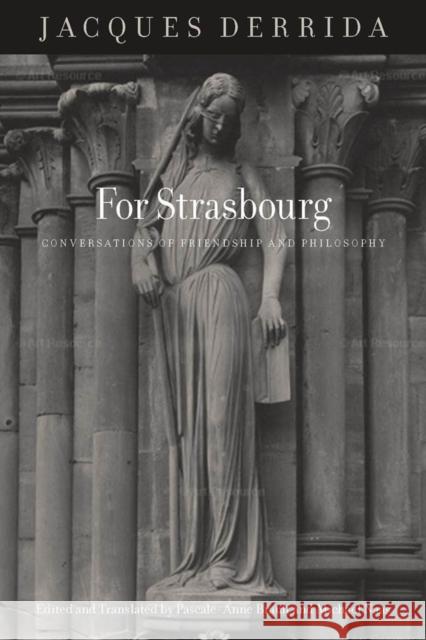
For Strasbourg consists of a series of essays and interviews about the city of Strasbourg and the philosophical friendships Jacques Derrida developed there over a period of some forty years. Written just months before his death, the opening essay, "The Place Name(s): Strasbourg," recounts in detail, and in very moving terms, Derrida's deep attachment to this French city on the border between France and Germany. More than just a personal narrative, however, the essay is a profound interrogation of the relationship between philosophy and place, philosophy and language, and philosophy and...
For Strasbourg consists of a series of essays and interviews about the city of Strasbourg and the philosophical friendships Jacques Derrida developed ...
For Strasbourg consists of a series of essays and interviews by French philosopher and literary theorist Jacques Derrida (1930-2004) about the city of Strasbourg and the philosophical friendships he developed there over a forty year period. Written just months before his death, the opening essay of the collection, "The place name(s): Strasbourg," recounts in great detail, and in very moving terms, Derrida's deep attachment to this French city on the border between France and Germany. More than just a personal narrative, however, it is a profound interrogation of the relationship...
For Strasbourg consists of a series of essays and interviews by French philosopher and literary theorist Jacques Derrida (1930-2004) about th...