Death is the opposite not of life, but of power. And as such, Mohammed Bamyeh argues in this original work, death has had a great and largely unexplored impact on the thinking of governance throughout history, right down to our day. In "Of Death and Dominion" Bamyeh pursues the idea that a deep concern with death is, in fact, the basis of the ideological foundations of all political systems.
Concentrating on four types of political systems polis, empire, theocracy, and modern mass society systems Bamyeh shows how each follows a specific strategy designed to pit power against the...
Death is the opposite not of life, but of power. And as such, Mohammed Bamyeh argues in this original work, death has had a great and largely unexp...
Death is the opposite not of life, but of power. And as such, Mohammed Bamyeh argues in this original work, death has had a great and largely unexplored impact on the thinking of governance throughout history, right down to our day. In "Of Death and Dominion" Bamyeh pursues the idea that a deep concern with death is, in fact, the basis of the ideological foundations of all political systems.
Concentrating on four types of political systems polis, empire, theocracy, and modern mass society systems Bamyeh shows how each follows a specific strategy designed to pit power against the...
Death is the opposite not of life, but of power. And as such, Mohammed Bamyeh argues in this original work, death has had a great and largely unexp...
The story of the origins of Islam provides a rich and suggestive example of sweeping cultural transformation. Incorporating both innovation and continuity, Islam built upon the existing cultural patterns among the peoples of the Arabian peninsula even as it threatened to eradicate these same patterns. In this provocative interdisciplinary study, Mohammed A. Bamyeh combines perspectives from sociology, literary studies, anthropology, and economic history to examine the cultural ecology that fostered Islam.
Highlighting the pivotal connections in pre-Islamic society between the emergence of...
The story of the origins of Islam provides a rich and suggestive example of sweeping cultural transformation. Incorporating both innovation and contin...
In the many decades of the Palestinian-Israeli conflict, the full complexity of that strife has seldom been heard. This work seeks to intervene by offering a critique of the Palestinian experience. Mapping the complicated relationship among Palestine, the United States, and Israel, this book includes critical essays on the politics, culture, literature, and history of the Palestinian people. The Nation to scholars in Arab, Jewish, and comparative literary studies, this work considers Palestinian gender and identity and their relationship to the conflict with Israel as represented in film,...
In the many decades of the Palestinian-Israeli conflict, the full complexity of that strife has seldom been heard. This work seeks to intervene by off...
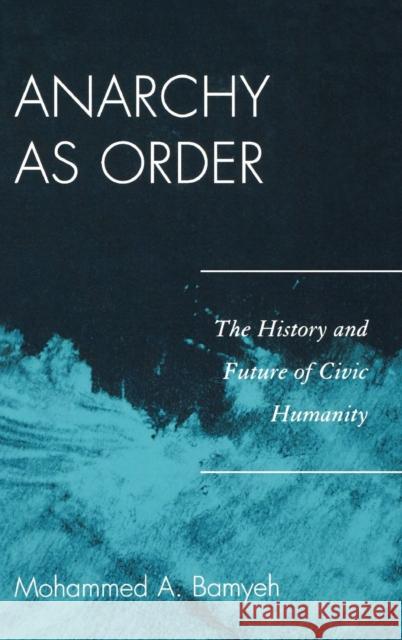
This original and impressively researched book explores the concept of anarchy--"unimposed order"--as the most humane and stable form of order in a chaotic world. Mohammed A. Bamyeh traces the historical foundations of anarchy and convincingly presents it as an alternative to both tyranny and democracy. He shows how anarchy is the best manifestation of civic order, of a healthy civil society, and of humanity's noblest attributes. The author contends that humanity thrives on self-regulation rather than imposed order, that large systems are inherently more prone to tyranny than small systems,...
This original and impressively researched book explores the concept of anarchy--"unimposed order"--as the most humane and stable form of order in a ch...