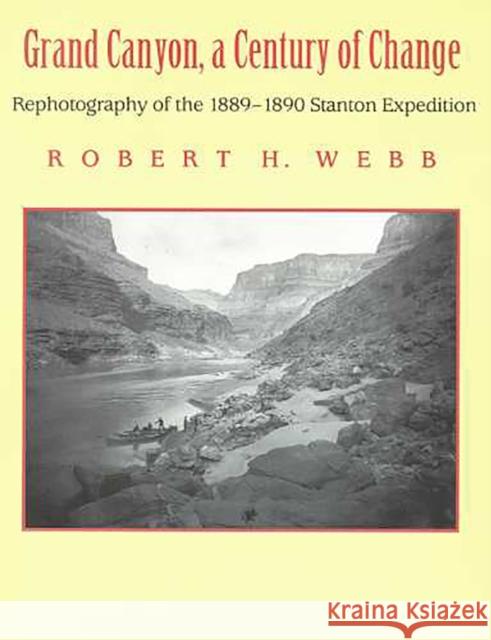
Photographs made in Grand Canyon a century ago may provide us today with a sense of history; photographs made a century later from the same vantage points give us a more precise picture of change in this seemingly timeless place. Between 1889 and 1890, Robert Brewster Stanton made photographs every 1-2 miles through the river corridor for the purpose of planning a water-level railroad route and produced the largest collection of photographs of the Colorado River at one point in time. Robert Webb, a USGS hydrologist conducting research on debris flows in the Canyon, obtained the...
Photographs made in Grand Canyon a century ago may provide us today with a sense of history; photographs made a century later from the same van...
No one in America would deny that the weather has changed drastically in our lifetime. We read about El Nino and La Nina, but how many of us really understand the big picture beyond our own front windows or even the headlines on the Weather Channel? Hydrologists and climatologists have long been aware of the role of regional climate in predicting floods and understanding droughts. But with our growing sense of a variable climate, it is important to reassess these natural disasters not as isolated events but as related phenomena. This book shows that floods and droughts don't...
No one in America would deny that the weather has changed drastically in our lifetime. We read about El Nino and La Nina, but how many of us re...
The Changing Mile, originally published in 1965, was a benchmark in ecological studies, demonstrating the prevalence of change in a seemingly changeless place. Photographs made throughout the Sonoran Desert region in the late 1800s and early 1900s were juxtaposed with photographs of the same locations taken many decades later. The nearly one hundred pairs of images revealed that climate has played a strong role in initiating many changes in the region. This new book updates the classic by adding recent photographs to the original pairs, providing another three decades of data...
The Changing Mile, originally published in 1965, was a benchmark in ecological studies, demonstrating the prevalence of change in a se...
Woody wetlands constitute a relatively small but extremely important part of the landscape in the southwestern United States. These riparian habitats support more than one-third of the region s vascular plant species, are home to a variety of wildlife, and provide essential havens for dozens of migratory animals. Because of their limited size and disproportionately high biological value, the goal of protecting wetland environments frequently takes priority over nearly all other habitat types. In The Ribbon of Green, hydrologists Robert H. Webb, and Stanley A. Leake and botanist Raymond M....
Woody wetlands constitute a relatively small but extremely important part of the landscape in the southwestern United States. These riparian habitats ...