Perhaps the most famous proposition in the history of philosophy is Descartes' cogito "I think therefore I am." Husain Sarkar claims in this provocative new interpretation of Descartes that the ancient tradition of reading the cogito as an argument is mistaken. It should, he says, be read as an intuition. Through this new interpretative lens, Sarkar reconsiders key Cartesian topics. He demonstrates how Descartes' attempt to prove the existence of God is foiled by a new Cartesian Circle.
Perhaps the most famous proposition in the history of philosophy is Descartes' cogito "I think therefore I am." Husain Sarkar claims in this provocati...
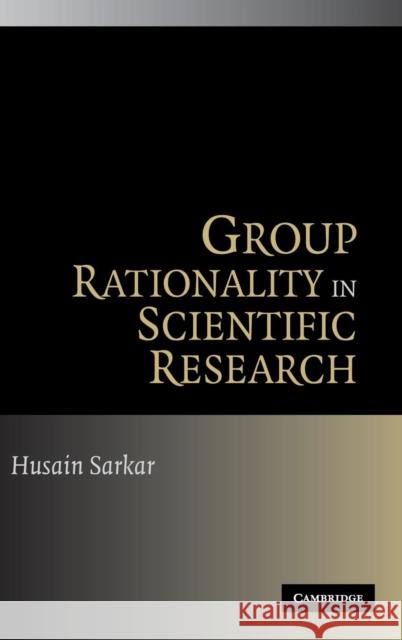
Under what conditions is a group of scientists rational? How would rational scientists collectively agree to make their group more effective? What sorts of negotiations would occur among them and under what conditions? What effect would their final agreement have on science and society? These questions have been central to the philosophy of science for the last two decades. In this book, Husain Sarkar proposes answers to them by building on classical solutions - the skeptical view, two versions of the subjectivist view, the objectivist view, and the view of Hilary Putnam.
Under what conditions is a group of scientists rational? How would rational scientists collectively agree to make their group more effective? What sor...
Perhaps the most famous proposition in the history of philosophy is Descartes' cogito "I think therefore I am." Husain Sarkar claims in this provocative new interpretation of Descartes that the ancient tradition of reading the cogito as an argument is mistaken. It should, he says, be read as an intuition. Through this new interpretative lens, Sarkar reconsiders key Cartesian topics. He demonstrates how Descartes' attempt to prove the existence of God is foiled by a new Cartesian Circle.
Perhaps the most famous proposition in the history of philosophy is Descartes' cogito "I think therefore I am." Husain Sarkar claims in this provocati...
Under what conditions is a group of scientists rational? How would rational scientists collectively agree to make their group more effective? What sorts of negotiations would occur among them and under what conditions? What effect would their final agreement have on science and society? These questions have been central to the philosophy of science for the last two decades. In this book, Husain Sarkar proposes answers to them by building on classical solutions - the skeptical view, two versions of the subjectivist view, the objectivist view, and the view of Hilary Putnam.
Under what conditions is a group of scientists rational? How would rational scientists collectively agree to make their group more effective? What sor...