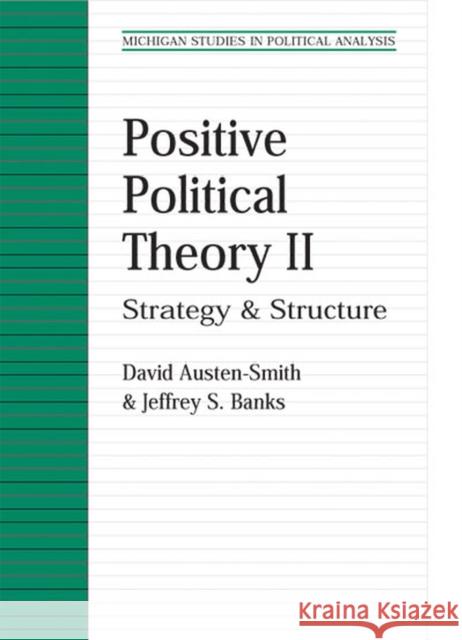
A major piece of work . . . a classic. There is no other book like it. Norman Schofield, Washington University The authors succeed brilliantly in tackling a large number of important questions concerning the interaction among voters and elected representatives in the political arena, using a common, rigorous language. Antonio Merlo, University of Pennsylvania Positive Political Theory II: Strategy and Structure is the second volume in Jeffrey Banks and David Austen-Smith s monumental study of the links between individual preferences and...
A major piece of work . . . a classic. There is no other book like it. Norman Schofield, Washington University The authors succeed brillia...
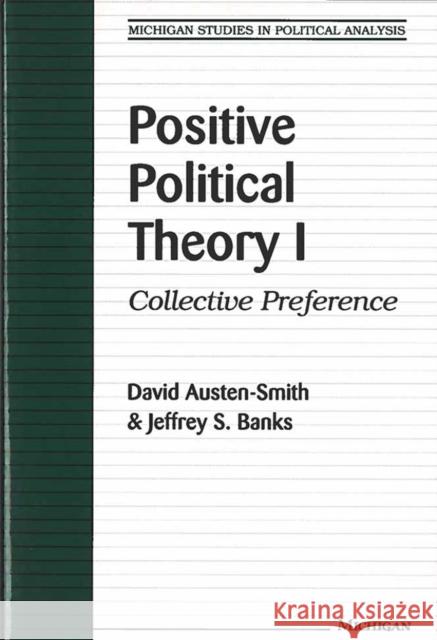
Positive Political Theory I is concerned with the formal theory of preference aggregation for collective choice. The theory is developed as generally as possible, covering classes of aggregation methods that include such well-known examples as majority and unanimity rule and focusing in particular on the extent to which any aggregation method is assured to yield a set of "best" alternatives. The book is intended both as a contribution to the theory of collective choice and a pedagogic tool. Austen-Smith and Banks have made the exposition both rigorous and accessible to people with...
Positive Political Theory I is concerned with the formal theory of preference aggregation for collective choice. The theory is developed as gen...
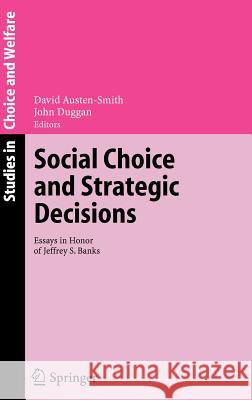
Social choices, about expenditures on government programs, or about public policy more broadly, or indeed from any conceivable set of alternatives, are determined by politics. This book is a collection of essays that tie together the fields spanned by Jeffrey S. Banks' research on this subject. It examines the strategic aspects of political decision-making, including the choices of voters in committees, the positioning of candidates in electoral campaigns, and the behavior of parties in legislatures. The chapters of this book contribute to the theory of voting with incomplete information, to...
Social choices, about expenditures on government programs, or about public policy more broadly, or indeed from any conceivable set of alternatives, ar...
Social choices, about expenditures on government programs, or about public policy more broadly, or indeed from any conceivable set of alternatives, are determined by politics. This book is a collection of essays that tie together the fields spanned by Jeffrey S. Banks' research on this subject. It examines the strategic aspects of political decision-making, including the choices of voters in committees, the positioning of candidates in electoral campaigns, and the behavior of parties in legislatures. The chapters of this book contribute to the theory of voting with incomplete information, to...
Social choices, about expenditures on government programs, or about public policy more broadly, or indeed from any conceivable set of alternatives, ar...