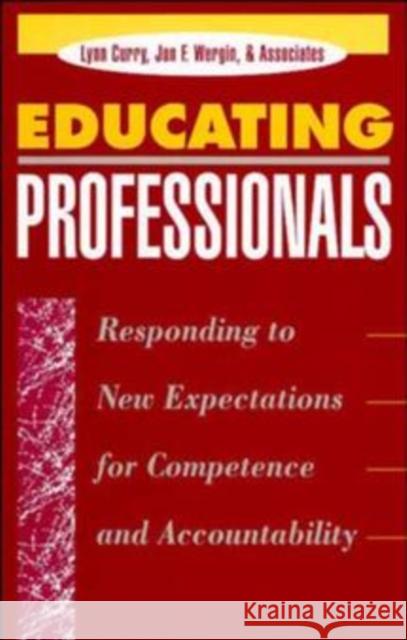
What should be the priorities for change in professional education as we move into the 21st century? How is it likely that change will occur? This book discusses how to educate professionals for practice in the 21st century and how that education needs to be different from the way it is today.
What should be the priorities for change in professional education as we move into the 21st century? How is it likely that change will occur? This boo...
Evaluation in departments is widespread but often fails to spark positive change. Based on his extensive work with academic departments across the country, Wergin explains that successful department evaluation exists only when faculty and departments have a strong influence on the purposes, processes, and methods of evaluation. The central purpose of Departments That Work is how academic programs can make evaluation more useful and critical reflection more likely.
Topics include: * How quality has become confused with such concepts as effectiveness, productivity, and...
Evaluation in departments is widespread but often fails to spark positive change. Based on his extensive work with academic departments across the cou...
For courses in Research Methods in Education. Understanding and Evaluating Research, third edition, is a supplemental textbook appropriate for all courses in educational research. A reader, this text contains quantitative and qualitative educational research articles from a variety of professional journals. With each article is a sample article analysis and exercises that help students become better consumers of research. The third edition is greatly enhanced by the inclusion of a new chapter on "Mixed Method Designs" and two mixed-method studies, revised and...
For courses in Research Methods in Education. Understanding and Evaluating Research, third edition, is a supplemental textbook app...
Reports the results of a survey to locate campus evaluation policies and practices that encourage constructive change in departments and a stronger culture of collective responsibility for the unit's success. Specific recommendations are offered-ideas that could aid in creating a more -self-regarding- institution, stronger and more widely accepted methods for evaluating departments and collectives, and eventually greater flexibility for departmental faculty.
The authors review materials from 130 institutions, following visits to eight campuses, and identify the key components: (1)...
Reports the results of a survey to locate campus evaluation policies and practices that encourage constructive change in departments and a stronger cu...