Papers presented at a symposium at the annual meeting of the South-eastern Archaeological Conference, held in Nashville, Tenn., November 1986, explore the wide range of societal organization during the Late Woodland period (A.D. 600-900) in the Southeast, and address explicitly the kinds of explanat
Papers presented at a symposium at the annual meeting of the South-eastern Archaeological Conference, held in Nashville, Tenn., November 1986, explore...
Michael S. Nassaney Eric S. Johnson Charles E. Cleland
"A thoughtful, disciplined, and useful work. . . . The issue of how to interpret North American Native cultures, in all their complexity and diversity, is one that historians, archaeologists, and other behavioral scientists have wrestled with for a long time. This volume is an interesting indicator of where that struggle currently stands."--James W. Bradley, director, Robert S. Peabody Museum, Phillips Academy, Andover, Massachusetts"A useful, interesting, and up-to-date introduction to how scholars are using material culture to better understand Native American life. Nassaney and Johnson...
"A thoughtful, disciplined, and useful work. . . . The issue of how to interpret North American Native cultures, in all their complexity and diversity...
Saitta examines historical archaeology s success in reconstructing collective social action in the past and considers the implications of these reconstructions for society today. Recognizing that studies of the past can serve different social interests, creating knowledge that can be used to oppress or emancipate elements of society, Saitta argues that historical archaeology needs to move beyond its emphasis on recovering the individual to acknowledging and asserting its power to effect social change.Developing a theoretical and methodological approach to the archaeology of collective action,...
Saitta examines historical archaeology s success in reconstructing collective social action in the past and considers the implications of these recons...
Elanor Conlin Casella Eleanor Conlin Casella Michael S. Nassaney
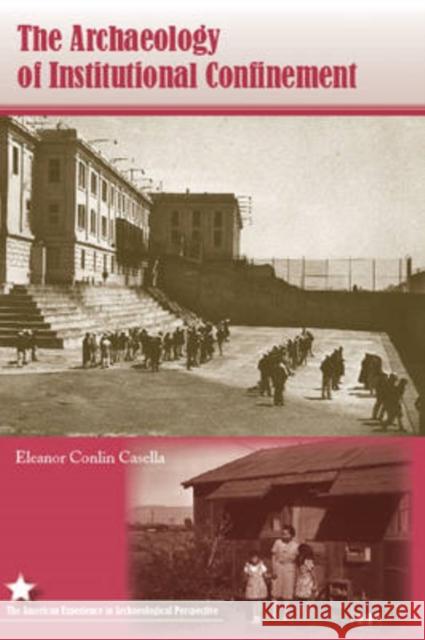
The study of American institutional confinement, its presumed successes, failures, and controversies, is incomplete without examining the remnants of relevant sites no longer standing.Asking what archaeological perspectives add to the understanding of such a provocative topic, Eleanor Conlin Casella describes multiple sites and identifies three distinct categories of confinement: places for punishment, for asylum, and for exile. Her discussion encompasses the multifunctional shelters of the colonial era, Civil War prison camps, Japanese-American relocation centers, and the maximum-security...
The study of American institutional confinement, its presumed successes, failures, and controversies, is incomplete without examining the remnants of ...
While the early cultural clashes between Native Americans and Europeans have long engaged scholars, far less attention has been paid to interactions among indigenous peoples themselves prior to the contact period. The essays in this volume, derived largely from the 1992 meeting of the Southeastern Archaeological Conference, mark a major step in correcting that imbalance. Long before Europeans sailed west in search of the East, Native Americans of various ethnic groups were encountering each other and interacting socially, both amicably and otherwise. Over the course of ten thousand years -...
While the early cultural clashes between Native Americans and Europeans have long engaged scholars, far less attention has been paid to interactions a...
"Nassaney draws together an amazing amount of information about the fur trades that once existed in North America and includes illuminating and imaginative interpretations of archaeological data by researchers from across the continent."--Gregory A. Waselkov, author of A Conquering Spirit: Fort Mims and the Redstick War of 1813-1814 "The Archaeology of the North American Fur Trade demonstrates how an amazing number of issues constellate around the subject: the mutual effects of cultural interaction, colonialism, world-systems theory, questions about dependence and local...
"Nassaney draws together an amazing amount of information about the fur trades that once existed in North America and includes illuminating and imagin...
"A fine piece of scholarship. . . . A solid introduction to the archaeology of the fur trade, as well as to the myriad archaeological issues associated with colonial interaction."--American Antiquity "Impressive and ambitious, covering centuries of time and much of the North American continent. . . . Admirably balances the enormous numbers of sites, peoples, historical events, and colonial enterprises with some of the important research directions that have defined and are defining the field of fur trade studies in archaeology. . . . Absorbing."--Midcontinental Journal of Archaeology...
"A fine piece of scholarship. . . . A solid introduction to the archaeology of the fur trade, as well as to the myriad archaeological issues associate...