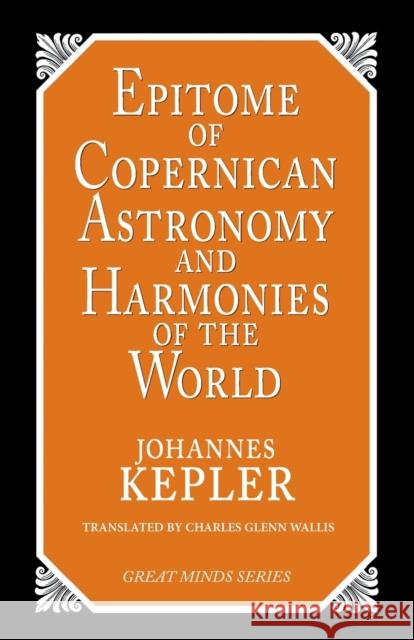
The authors have presented and interpreted Johannes Kepler's Latin text to English readers by putting it into the kind of clear but earnest language they suppose Kepler would have used if he had been writing today.
The authors have presented and interpreted Johannes Kepler's Latin text to English readers by putting it into the kind of clear but earnest language t...
The brilliant German mathematician Johannes Kepler (1571-1630), one of the founders of modern astronomy, revolutionized the Copernican heliocentric theory of the universe with his three laws of motion: that the planets move not in circular but elliptical orbits, that their speed is greatest when nearest the sun, and that the sun and planets form an integrated system. This volume contains two of his most important works: The Epitome of Copernican Astronomy (books 4 and 5 of which are translated here) is a textbook of Copernican science, remarkable for the prominence given to physical astronomy...
The brilliant German mathematician Johannes Kepler (1571-1630), one of the founders of modern astronomy, revolutionized the Copernican heliocentric th...
Kepler hat bei seinen Versuchen zur Planetenbewegung als erster die vollkommene Kreisbewegung verworfen. Erst bei der Betrachtung elliptischer Bahnen fand er die lange gesuchte Ubereinstimmung mit Tycho Brahes Messwerten. Dieses Gesetz veroffentlichte Kepler in seiner 1609 erschienenen Arbeit Astronomia nova."
Kepler hat bei seinen Versuchen zur Planetenbewegung als erster die vollkommene Kreisbewegung verworfen. Erst bei der Betrachtung elliptischer Bahnen ...
Johannes Kepler Jacques Bromberg Guillermo Bleichmar
"In 1611, Kepler wrote an essay wondering why snowflakes always had perfect, sixfold symmetry. It's a simple enough question, but one that no one had ever asked before and one that couldn't actually be answered for another three centuries. Still, in trying to work out an answer, Kepler raised some fascinating questions about physics, math, and biology, and now you can watch in wonder as a great scientific genius unleashes the full force of his intellect on a seemingly trivial question, complete with new illustrations and essays to put it all in perspective."io9, from their list "10 Amazing...
"In 1611, Kepler wrote an essay wondering why snowflakes always had perfect, sixfold symmetry. It's a simple enough question, but one that no one h...
Kepler's essay, On the Six-Cornered Snowflake, provides the first published evidence of the ideas of regular arrangements and close-packing which have proved fundamental to crystallography. In it, Kepler ponders on the problem of why snowflakes are hexagonal, two centuries before the first successful steps were taken towards its solution. The purpose of this volume is to display the historical, literary, scientific, and philosophical treasures of Kepler's essay. The book includes the modernized text of the 1611 Latin edition, with an English translation by Colin Hardie on the opposite...
Kepler's essay, On the Six-Cornered Snowflake, provides the first published evidence of the ideas of regular arrangements and close-packing which have...
Thank you for checking out this book by Theophania Publishing. We appreciate your business and look forward to serving you soon. We have thousands of titles available, and we invite you to search for us by name, contact us via our website, or download our most recent catalogues. Concerning the very perfect harmony of the celestial movements, and the genesis of eccentricities and the semidiameters, and the periodic times from the same. After the model of the most correct astronomical doctrine of today, and the hypothesis not only of Copernicus but also of Tycho Brahe, whereof either hypotheses...
Thank you for checking out this book by Theophania Publishing. We appreciate your business and look forward to serving you soon. We have thousands of ...
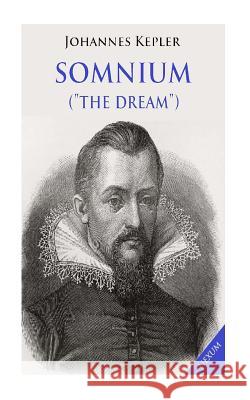
According to Carl Sagan and Isaac Asimov, Keplers "Somnium" ("The Dream"), written around 1611, should be considered the first science-fiction novel ever. The eminent astronomer Johannes Kepler imagines a trip to the moon and speculates about its inhabitants and astronomy."
According to Carl Sagan and Isaac Asimov, Keplers "Somnium" ("The Dream"), written around 1611, should be considered the first science-fiction novel e...