"It is wrong always, everywhere, and for anyone, to believe anything upon insufficient evidence." -- W. K. Clifford The above forthright assertion of mathematician and educator W. K. Clifford (1845-1879) in his famous essay "The Ethics of Belief" drew an immediate response from Victorian-era critics, who took issue with his reasoned and brilliantly presented attack on beliefs "not founded on fair inquiry." An advocate of evolutionary theory, Clifford recognized that working hypotheses and assumptions are necessary for belief formation and that testing and assessing one's beliefs in...
"It is wrong always, everywhere, and for anyone, to believe anything upon insufficient evidence." -- W. K. Clifford The above forthright assert...
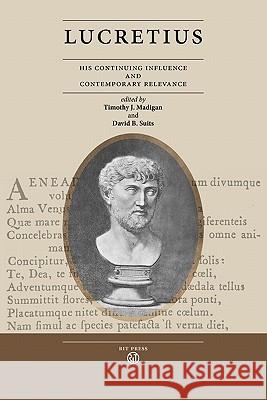
The essays in this collection deal with Greek philosopher Lucretius's critique of religion, his critique of traditional attitudes about death, and his influences on later thinkers such as Isaac Newton and Alfred Tennyson. 144 pp.
The essays in this collection deal with Greek philosopher Lucretius's critique of religion, his critique of traditional attitudes about death, and his...