One of the main problems in the the study of Parmenides' poem is establishing the meaning of e0/00nai, 'to be'. Scholars often simply take it to mean: 'to exist', 'to be the case', 'to be so', or regard it as a copula. It's better to start by fathoming what Parmenides himself has to say about to be and about Being. This cannot be done without recognizing the logical pattern in his poem. Another main problem is: what does not-Being mean? Is the so-called Doxa - as not-Being - a non-existing, hallucinatory world, an illusion, a fata morgana? Or is it only a detector of lies? In the present work...
One of the main problems in the the study of Parmenides' poem is establishing the meaning of e0/00nai, 'to be'. Scholars often simply take it to mean:...
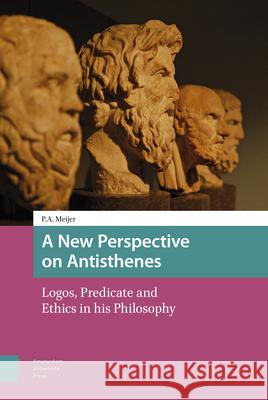
Antisthenes (c. 445- c. 365 BC) was a prominent follower of Socrates and bitter rival of Plato. In this revisionary account of his philosophy in all its aspects, P. A. Meijer claims that Plato and Aristotle have corrupted our perspective on this witty and ingenious thinker. The first part of the book reexamines afresh Antisthenes' ideas about definition and predication and concludes from these that Antisthenes never held the (in)famous theory that contradiction is impossible. The second part of the book argues that Antisthenes' logical theories bear directly on his activities as an exegete of...
Antisthenes (c. 445- c. 365 BC) was a prominent follower of Socrates and bitter rival of Plato. In this revisionary account of his philosophy in all i...