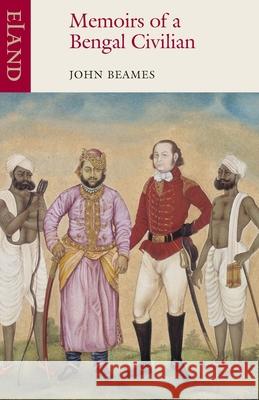
No one could have invented John Beames, whose vibrant and original memoirs were discovered by chance in an attic almost a century after they were written. He arrived in India in 1858, the year after the Mutiny, and worked there as a civil servant for the next thirty-five years, defending powerless peasants against rapacious planters, improvising fifteen-gun salutes for visiting dignitaries, and presiding over the blissful coast of Orissa. His acquaintances spanned from lofty Rajas to dissolute Englishmen. Vivid, candid, and without fear of authority. Beames was a defiant individual in a huge...
No one could have invented John Beames, whose vibrant and original memoirs were discovered by chance in an attic almost a century after they were writ...
Many of the earliest books, particularly those dating back to the 1900s and before, are now extremely scarce and increasingly expensive. We are republishing these classic works in affordable, high quality, modern editions, using the original text and artwork.
Many of the earliest books, particularly those dating back to the 1900s and before, are now extremely scarce and increasingly expensive. We are republ...
The Indo-Aryan language family is a branch of the Indo-European phylum, and includes Hindi, Urdu, Bengali, Punjabi, Kashmiri and Gujarati. First published in 1875, this three-volume comparative grammar of the family was written by the British civil servant John Beames (1837 1902). From 1866 he spent twelve years in India, during which he gathered data for what he intended to be the first comprehensive and accurate Indo-Aryan grammar. Volume 3 focuses on verbs. It begins by describing the structure of Sanskrit verbs, showing them to be the origin of the analytical verb constructions found in...
The Indo-Aryan language family is a branch of the Indo-European phylum, and includes Hindi, Urdu, Bengali, Punjabi, Kashmiri and Gujarati. First publi...
The Indo-Aryan language family is a branch of the Indo-European phylum, and includes Hindi, Urdu, Bengali, Punjabi, Kashmiri and Gujarati. First published in 1875, this three-volume comparative grammar of the family was written by the British civil servant John Beames (1837 1902). From 1866 he spent twelve years in India, during which he gathered data for what he intended to be the first comprehensive and accurate Indo-Aryan grammar. Volume 2 focuses on nouns and pronouns. It begins by looking at the stems and suffixes that form Indo-Aryan nouns, and compares their systems of inflection for...
The Indo-Aryan language family is a branch of the Indo-European phylum, and includes Hindi, Urdu, Bengali, Punjabi, Kashmiri and Gujarati. First publi...
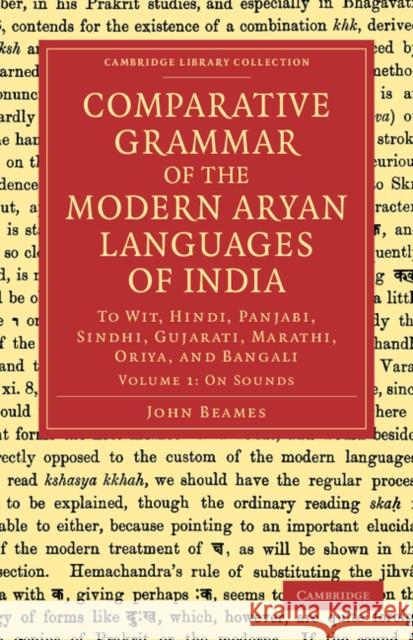
The Indo-Aryan language family is a branch of the Indo-European phylum, and includes Hindi, Urdu, Bengali, Punjabi, Kashmiri and Gujarati. First published in 1872, this three-volume comparative grammar of the family was written by the British civil servant John Beames (1837 1902). From 1866 he spent twelve years in India, during which he gathered data for what he intended to be the first comprehensive and accurate Indo-Aryan grammar. Volume 1 focuses on phonetics and phonology. Drawing on evidence from Indo-Aryan sound systems, it shows Sanskrit to be the languages' parent, while exploring...
The Indo-Aryan language family is a branch of the Indo-European phylum, and includes Hindi, Urdu, Bengali, Punjabi, Kashmiri and Gujarati. First publi...